How to Load a Platform Cart Safely: Stacking and Balance
A platform cart can move an enormous amount of weight, but only if the load is set up correctly. Most cart accidents do not come from overloading alone. They come from a poorly stacked load that shifts, tips over a wheel, or blocks the operator's view. Knowing how to load a platform cart safely protects your back, your products, and the people working around you.
This guide covers weight distribution, stacking order, securing loads, and safe pushing technique for warehouses, stockrooms, garages, and moving day.

Before You Load: Check the Cart and the Route
A thirty-second check prevents most problems:
- Know the rated capacity. Find the weight capacity on the product page or label and estimate the weight of what you are moving. Stay comfortably under the rating.
- Inspect the wheels. Make sure every caster spins and swivels freely and that nothing is wrapped around an axle.
- Check the handle. On a folding cart, confirm the handle is fully raised and locked before you load.
- Walk the route. Look for thresholds, cords, wet floors, ramps, and tight doorways. Clear the path before the cart is heavy.
How to Load a Platform Cart Safely: Weight Distribution Basics
Good weight distribution keeps the cart stable and easier to steer. Follow these rules every time:
- Heaviest items first and lowest. Place the heaviest boxes flat on the deck. A low center of gravity is the single biggest factor in keeping a load upright.
- Center the weight. Spread heavy items evenly across the platform rather than piling them on one side or one end. An off-center load pulls the cart sideways and can tip over a caster.
- Keep heavy items slightly toward the handle. Weight near the handle end helps you control the cart and keeps the far end from diving on slopes.
- Build a stable base. Use the largest, sturdiest boxes as the bottom layer, then stack smaller and lighter items on top.
- Do not overhang the deck. Items that hang past the edges catch on door frames, shelving, and people.
Stacking Height and Visibility
Tall loads are the most common cause of tip-overs and collisions. Keep your stack low enough that you can see over it when standing at the handle. If you cannot see the floor ahead, split the load into two trips. Stack boxes in an interlocking pattern, like bricks, so each layer ties the one below together. Never put loose or round items on top of a tall stack.
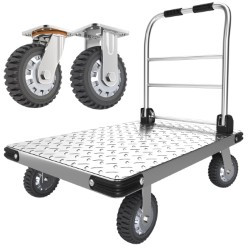
The Folding Hand Truck Dolly Cart 660lbs has a support guard that helps keep items from sliding back and a non-slip textured platform that helps hold loads in place. It rolls on four heavy-duty wheels, including two 360 degree swivel wheels for tight corners, and the padded handle folds flush with the platform for storage.

Securing the Load
Even a well-stacked load can shift when the cart hits a bump. Secure it before you move:
- Use straps or stretch wrap for tall or mixed loads so boxes move as one unit.
- Fill gaps between boxes so nothing can slide into the empty space during a turn.
- Keep liquids upright and low, and close every lid and cap.
- Lay long items flat and centered, and never let them stick out past the deck where they can swing into people or shelving.
Pushing, Turning, and Stopping
Push, do not pull
Pushing lets you use your body weight and keeps the cart in view. Pulling a heavy cart behind you puts strain on your shoulders and back and makes it easy for the cart to roll into your heels.
Start and stop gradually
Heavy loads build momentum. Start slowly, keep a walking pace, and begin slowing well before corners, doors, and the end of the aisle.
Take turns wide
Swivel casters make turning easy, but a quick turn can shift a tall stack. Slow down and make wide, smooth turns.
Handle ramps with care
Keep loads low on any slope, move slowly, and get a second person to help with heavy loads. Avoid stairs with a platform cart.
Choosing a Cart That Matches Your Loads
The safest load starts with the right cart. Match capacity and deck size to your heaviest regular job:
- Home moves, stockrooms, and deliveries: the 660 lb Folding Hand Truck Dolly Cart folds flat for a closet or trunk.
- Larger boxes and heavier equipment: the 2000 lb Folding Hand Truck Dolly Cart is steel, has a 36 in. x 24 in. flatbed, rolls on 360 degree swivel wheels, and folds for storage.
- Industrial and warehouse loads: the Heavy Duty Flatbed Platform Cart is heavy-duty steel with a 3,000 lb capacity, in black or silver.

Safety note: never exceed the rated capacity, lift with your legs when placing heavy items on the deck, wear closed-toe shoes, and never ride on a platform cart.
Frequently Asked Questions
Where should the heaviest items go on a platform cart?
On the bottom layer, flat on the deck, centered side to side and slightly toward the handle end. This keeps the center of gravity low and makes the cart easier to control.
How high can I stack boxes on a platform cart?
Keep the stack low enough that you can see over it from the handle. If the load blocks your view or feels top-heavy, split it into two trips.
Should I push or pull a loaded platform cart?
Push whenever possible. Pushing gives better control and visibility and puts less strain on your back and shoulders.
Can I load a platform cart to its full rated capacity?
The rating is a maximum, not a target. For everyday work, stay comfortably below it, especially on ramps, rough floors, or when the load is tall.
Load Smarter and Move Safer
A low, centered, secured load is the key to moving heavy items without damage or injury. Pick the right capacity with the 660 lb folding cart, the 2000 lb folding platform cart, or the 3000 lb flatbed platform cart, and browse all warehouse carts and trucks to equip your team.
Recent Posts
-
How to Load a Platform Cart Safely: Stacking and Balance
A platform cart can move an enormous amount of weight, but only if the load is set up correctly. Mos …Oct 27, 2026 -
Cookie Decorating Station Setup With a Folding Table
Holiday cookie decorating is one of the best traditions of the season, and one of the messiest. Spri …Oct 27, 2026 -
Renting vs Buying Folding Chairs: Which Makes Sense
Every time a birthday party, graduation, or holiday gathering comes up, the same question follows: s …Oct 27, 2026