
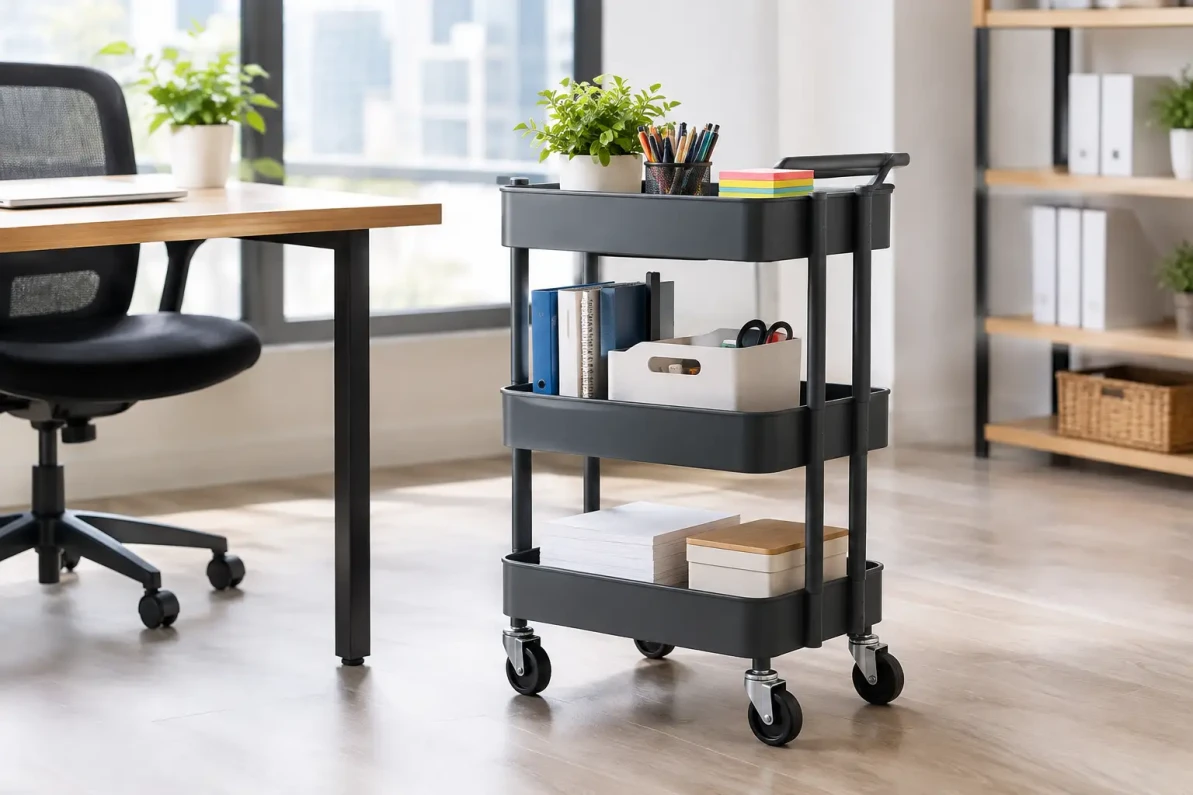
Office Supply Cart Guide for Smarter Workspaces
A supply closet may hold plenty of inventory, but it does not help much when envelopes, labels, paper, toner, and cleaning basics need to get to the people using them. This office supply cart guide explains how to choose a rolling cart that keeps everyday materials close, cuts down on repeated trips, and fits the way your workspace actually operates.
A good cart is not just a place to stack boxes. It is a mobile work station, restocking tool, and temporary storage spot. The right choice depends on what you move, how far it travels, where it is stored, and whether one person or a whole team will use it.
Start With the Job the Cart Needs to Do
Before comparing shelf counts or wheel styles, identify the cart's main role. A small office may need a compact cart for printer paper, pens, folders, and mail supplies. A property manager may need one that carries light maintenance items between units. A shipping area may need a sturdier rolling cart for labels, tape, mailers, and boxed inventory.
The load is only part of the equation. Consider how often the cart moves. A cart that stays beside a copier can be larger and may not need the same wheel quality as one that crosses a warehouse floor several times each day. Likewise, a cart used in a narrow hallway needs a manageable footprint and easy steering more than maximum shelf space.
It helps to measure the route before buying. Check doorways, elevator openings, aisle widths, turns around desks, and the available parking spot. A cart that is technically large enough for supplies can still become frustrating if it blocks traffic or cannot fit through the spaces it needs to serve.
Choose the Right Office Supply Cart Size and Layout
Cart dimensions affect storage, maneuverability, and how likely people are to use it correctly. Large carts reduce restocking trips, but they can become dumping grounds if they do not have a clear layout. Smaller carts are easier to park beside a desk or printer, although they require more frequent refills.
Two-tier and three-tier carts
Two-tier carts work well when supplies are bulky or when staff need quick access to open boxes of paper, folders, or cleaning products. The taller shelf clearance can be more useful than adding another level. They also make sense for locations with limited vertical storage needs.
Three-tier utility carts are often the practical middle ground for shared offices, classrooms, mailrooms, and workrooms. Separate shelves make it easier to group supplies by purpose. For example, keep paper and labels on the bottom shelf, everyday stationery in the middle, and outgoing mail or frequently used tools on top.
More shelves are not always better. If you stock bulky reams of paper, tall bottles, or larger packages, shallow spacing can leave usable capacity wasted. Check both the outside dimensions and the clearance between shelves before deciding.
Open shelves, deep bins, and flat platforms
Open shelves provide visibility. They are useful for frequently used items because staff can see what is running low without moving containers around. Raised edges or lipped shelves can help stop small items from sliding off while the cart is in motion.
Deep bin-style shelves better contain loose supplies such as markers, tape rolls, gloves, and small packaged parts. The trade-off is that items at the bottom can be harder to spot. For mixed inventory, use small bins or clearly labeled containers inside the cart rather than letting unrelated supplies collect together.
Flat platform carts are a better match for cartons, office equipment, bulk paper, or heavier packaged stock. They do not organize small supplies on their own, but they offer a straightforward way to move larger loads from receiving areas to storage rooms or departments.
Capacity Means More Than a Weight Rating
Weight capacity matters, especially when the cart will carry paper, bottled products, boxed shipping supplies, or tools. However, the right capacity is not simply the largest number available. A heavier-duty cart may be the better value for regular commercial use, while an oversized option can be awkward for a small office with light loads.
Estimate a realistic full load, not just the weight of one item. A case of copy paper, a box of shipping labels, packing tape, and several smaller supplies add up quickly. Choose a cart with enough working margin so it is not constantly pushed at its limit.
Also consider how the weight is distributed. Put the heaviest materials on the lowest shelf to improve stability and make the cart easier to control. Keep lighter, frequently accessed items higher up. Avoid piling boxes above the handle height, where they can block the operator's view and shift during movement.
If several people will use the cart, clear loading habits matter as much as the cart itself. A simple shelf label such as “Paper,” “Shipping,” or “Restock” makes it easier to maintain an organized setup.
Wheels, Handles, and Brakes Make Daily Use Easier
A cart can have the right shelves and capacity yet still be difficult to use if the casters do not match the floor. Wheel selection affects rolling effort, noise, steering, and how well the cart handles transitions between surfaces.
Harder wheels can work well on smooth, level floors. Softer wheels may be a better choice where floors are uneven, where quieter movement is preferred, or where the cart crosses thresholds. Larger wheels generally roll more easily over small gaps and changes in flooring, while compact casters can help keep a cart's overall footprint smaller.
Swivel casters improve turning in tight spaces. Fixed wheels can support straight-line movement and help guide larger carts over longer routes. Many utility carts use a combination that balances steering with control.
Brakes are worth considering when the cart will be parked near work stations, loaded or unloaded on a slight incline, or used in active shared areas. They are especially helpful when the top shelf becomes a temporary packing or sorting surface. Test that the brake position is easy to reach and that it does not interfere with normal movement.
Handle placement matters, too. A comfortable handle gives the user better control and keeps hands away from stacked materials. On compact carts, the top shelf may serve as the pushing surface. That can work for light use, but a dedicated handle is often more convenient for frequent transport.
Match Cart Materials to the Work Area
Material choice should reflect the environment, expected load, and cleanup needs. There is no single best option for every office or stockroom.
Steel carts are commonly chosen for strength and long-term use in supply rooms, maintenance areas, and shipping stations. Look for a finish that is easy to wipe down and suited to indoor work environments. Metal construction can be a sensible choice when the cart handles denser loads or sees regular use.
Plastic utility carts are often lighter, easy to clean, and quieter in office settings. They can be a practical fit for everyday supplies, light packages, and shared work areas. Their weight and shelf design should still match the intended load.
Wire carts offer airflow and visibility, which can be useful for packaged inventory and quick stock checks. Small objects may need bins or trays so they do not fall through or become difficult to sort. Wood-look or furniture-style carts may suit a front office, but confirm that their wheels, shelves, and capacity are appropriate for actual daily use rather than occasional display.
Build a Cart Setup That Stays Organized
Buying the cart is the easy part. Keeping it useful requires a simple system that matches the people using it. Start by assigning each shelf a purpose. Do not mix outgoing mail with printer supplies, or cleaning products with labels and packing materials, unless the cart is intended for a specific task that requires all of them.
For a mobile printer station, stock only the items needed for quick refills: paper, labels, envelopes, replacement staples, and approved toner or ink storage if applicable. For a shipping cart, group materials in the order they are used: labels and documents on top, tape and markers in the middle, and mailers or small boxes below.
Use bins for loose items, but avoid creating too many tiny categories. A few clearly marked containers are easier to restock than a complicated system no one follows. Put high-use supplies within easy reach and reserve lower shelves for backup stock.
Set a refill point instead of waiting until the cart is empty. In a small business, that may mean checking it at the end of each week. In a busy mailroom or warehouse, staff may need to check stock at the end of every shift. This approach prevents a cart from becoming a half-stocked obstacle that no one trusts.
Common Buying Mistakes to Avoid
The most common mistake is choosing based on appearance alone. A slim cart may look ideal beside a desk, but shallow shelves can be limiting if it needs to hold paper boxes. On the other hand, a large industrial cart may be unnecessary when the job is simply moving small office supplies between two rooms.
Another issue is overlooking clearance. Measure shelf height for tall items and overall height for under-counter storage. Check the cart width against narrow doors and crowded aisles. If it will park in a closet, leave enough room to pull it out without rearranging everything around it.
Finally, do not treat the stated capacity as a reason to overload the top shelf. Keep loads balanced, make sure supplies are secure before moving, and use the cart for its intended purpose. These basic habits help the cart remain easier to maneuver and more useful over time.
The best office supply cart is the one that removes friction from a repeated task. Choose a size your space can handle, shelves that fit your actual supplies, and wheels that suit the route. With a clear restocking system, a practical utility cart can keep the workday moving without sending people back to the supply closet every hour.
Recent Posts
-

Folding Tables Versus Workbenches for Real Work
A garage project can change quickly: one day you are assembling shelves, and the next you need the f …Nov 15, 2026 -

Aluminum Versus Steel Ladders for Work and Home
A ladder that is awkward to carry often gets left in the garage. A ladder that is too light-duty for …Nov 14, 2026 -
Office Supply Cart Guide for Smarter Workspaces
A supply closet may hold plenty of inventory, but it does not help much when envelopes, labels, pape …Nov 13, 2026
