
Folding Tables Versus Workbenches for Real Work
A garage project can change quickly: one day you are assembling shelves, and the next you need the floor clear for a vehicle. That is the practical question behind folding tables versus workbenches. Both give you a usable work surface, but they solve very different space, storage, and workload problems.
A folding table is built for flexibility. A workbench is built to stay put and take repeated use. The better choice depends less on which one looks tougher and more on what you need it to do after the job is finished.
Folding Tables Versus Workbenches: The Basic Difference
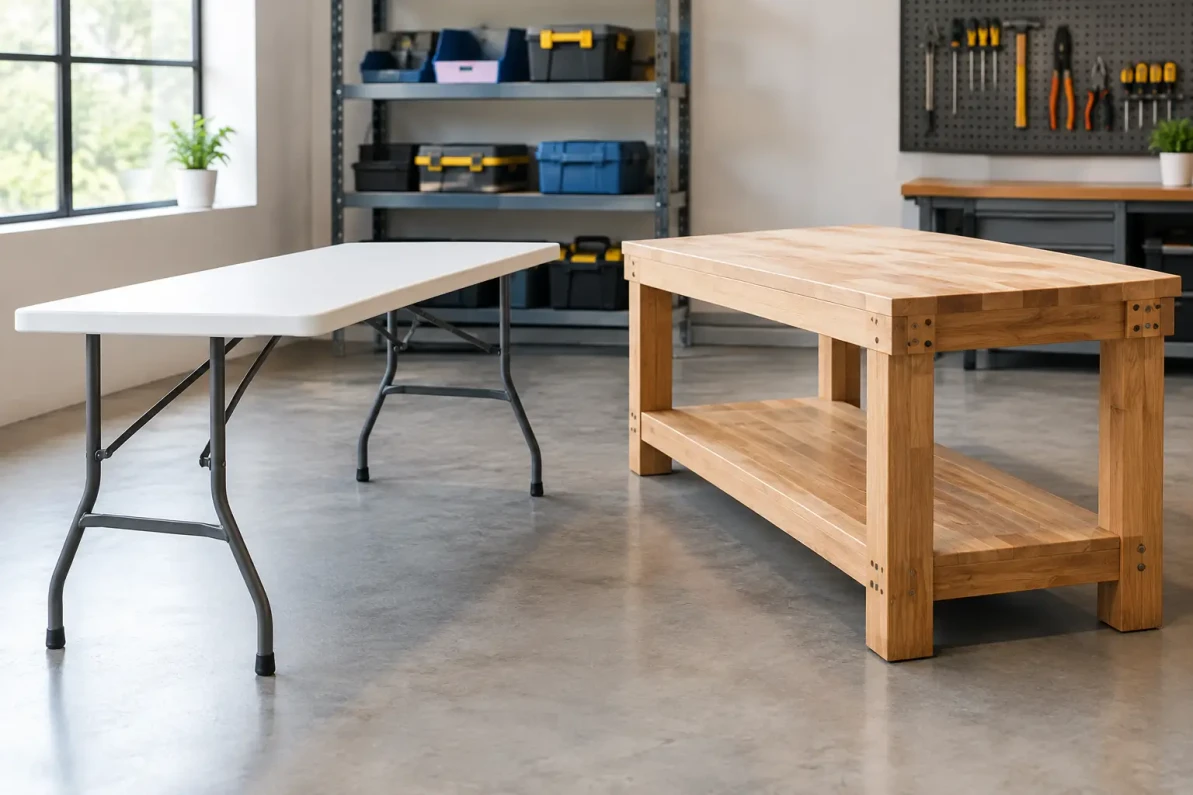
Folding tables are portable surfaces with legs that fold flat or inward for storage. They are commonly used for parties, meetings, packing stations, craft projects, temporary displays, and light-duty home tasks. Many are easy for one person to move, set up, and put away.
Workbenches are dedicated work surfaces designed for garages, workshops, maintenance rooms, and production areas. They may have steel frames, thick tops, lower shelves, drawers, pegboard panels, or built-in vises. Their main advantage is stability. A properly sized bench gives you a fixed place for repair work, cutting, assembly, and tool storage.
The distinction matters because a table that works well for labeling shipping boxes may be a poor fit for clamping lumber or servicing heavy equipment. Likewise, a permanent bench can waste valuable square footage if you only need a surface a few times each month.
When a Folding Table Makes More Sense
Choose a folding table when open floor space matters as much as the work surface. Renters, homeowners with one-car garages, event organizers, small online sellers, and property managers often need equipment that can disappear when it is not needed.
For example, a 6-foot folding table can serve as a weekend packing station for online orders, a place to sort maintenance supplies, or extra seating for an event. Afterward, it can fold flat and rest against a wall, fit in a storage closet, or travel in a vehicle. That flexibility is difficult for any fixed workbench to match.
Folding tables also work well when the task is clean and relatively light. Sorting inventory, assembling small household items, organizing bins, preparing packages, and setting out tools for a brief repair are all good uses. A wipe-clean plastic tabletop is especially practical around tape, labels, small parts, and everyday messes.
What to Check Before Buying a Folding Table
Weight capacity is the first number to review. Do not assume a larger tabletop automatically supports heavier loads. Capacity can vary by frame design, leg construction, tabletop material, and whether weight is spread evenly across the surface.
Also check the dimensions when the table is open and folded. A table that fits your room may still be difficult to store if there is no clear wall, closet, or shelving area for it. If you plan to transport it often, consider the folded profile, carrying handle, and total product weight.
Leg locks and cross-bracing are worth attention as well. For regular business use, such as packing and display setups, a stable frame helps prevent wobble while keeping work moving. Set the table on level ground and confirm that the legs are fully opened and locked before loading it.
When a Workbench Is the Better Investment
A workbench is the stronger choice when your work involves pressure, vibration, repeated assembly, or tools that need a stable base. Think of repairing appliances, maintaining equipment, building storage units, sanding wood, organizing a maintenance area, or preparing parts for installation.
Unlike a folding table, a workbench can stay arranged around the way you work. Tools can live on a lower shelf, fasteners can go into labeled bins, and frequently used items can remain within reach. That setup saves time for people who work in the same area every week.
Workbenches are also usually better for concentrated loads. A heavy item placed in one spot, the downward force of a clamp, or pressure from hand tools can strain a lightweight folding table even when the total load seems reasonable. A sturdy bench is made for more demanding, repeatable tasks.
A Workbench Needs a Real Home
The trade-off is permanent space. Before choosing a workbench, measure more than the width of the bench itself. Leave room to stand in front of it, open drawers, access shelves, and carry materials past it. In a garage, consider door swing, vehicle clearance, and where extension cords or carts will travel.
Bench height also affects day-to-day comfort and control. A surface used for detailed repairs may benefit from a different height than one used for packing large boxes. There is no single best measurement for every customer. Match the height to the work, the user, and whether you will stand or sit.
A bench with a lower shelf offers helpful storage, but keep the shelf clear enough to be useful. It is easy for a fixed workstation to become a catch-all for unopened boxes, spare parts, and tools that no longer have a designated place. Basic organization is what turns a bench into a productive work area.
Compare the Features That Actually Affect Your Work
When comparing folding tables and workbenches, start with the job rather than the product category. A few practical factors usually make the decision clearer.
Load type matters. An evenly distributed stack of lightweight shipping supplies is very different from a heavy motor component, a mounted vise, or a project that requires pushing, pulling, or clamping. For heavier or force-intensive work, use a workbench designed for that purpose.
Portability has value. If you work at different locations, need temporary tables for events, or must convert a room back to living space, a folding table earns its place. Fixed benches offer less mobility but better consistency.
Surface material affects cleanup and durability. Plastic folding tops are convenient for general-purpose use and quick cleanup. Bench tops may be wood, steel, or other materials selected for workshop tasks. Choose a surface that suits the materials, tools, and messes you expect to handle.
Storage can favor either option. A folding table stores compactly when closed, which is ideal for occasional use. A workbench can store more items while open, especially if it includes shelves or drawers. The right answer depends on whether you need to save floor space or keep supplies ready at all times.
Setup frequency changes the equation. Setting up a table once for a holiday gathering is easy. Opening and closing it every workday for order packing can become a nuisance. In that case, a dedicated bench or table may be worth the floor space.
The Hybrid Setup That Works for Many Customers
You do not always have to choose one or the other. Many garages, small businesses, and maintenance areas benefit from a fixed workbench plus one or two folding tables. The bench handles repairs and tool storage, while folding tables provide overflow space when a larger project arrives.
This approach is useful for e-commerce sellers. A workbench can hold the scale, label supplies, tape dispenser, and commonly used packaging. Folding tables can be opened when a large shipment needs sorting or when seasonal inventory arrives. Once the rush is over, the extra surfaces go back into storage.
For property maintenance, the same setup can keep routine tools organized while creating a temporary staging area for replacement parts, hardware, or room-by-room supplies. Utility carts can make the arrangement even more efficient by moving materials between storage, the work surface, and the job location.
Common Buying Mistakes to Avoid
The most common mistake is choosing only by price or tabletop size. A low-cost folding table can be a smart value for occasional light-duty use, but it should not be expected to replace a heavy workshop bench. Buying below your actual needs often leads to instability, damaged surfaces, or an early replacement.
Another mistake is ignoring folded dimensions and access paths. Measure doorways, storage areas, vehicle cargo space, and the route from where the product arrives to where it will be used. This is especially important for long tables and large workbenches.
Finally, do not overlook capacity limits. Keep heavy loads centered where possible, distribute materials across the surface, and avoid using a table or bench in a way that exceeds its intended design. Product specifications should guide the purchase, not assumptions based on appearance.
Choose the Surface That Fits the Next Job
If your priority is quick setup, easy storage, and multipurpose use, a folding table is often the practical buy. If you need a stable, dedicated area for tools, repairs, and repeated hands-on work, a workbench is usually the better long-term fit.
For customers who need dependable, value-focused options for homes, workshops, packing areas, and business operations, Easy Deal USA makes it easier to compare practical equipment by the details that matter: size, capacity, portability, and everyday usefulness. Pick the surface that supports your normal workload, then leave enough room for the next project to grow.
Recent Posts
-
Folding Tables Versus Workbenches for Real Work
A garage project can change quickly: one day you are assembling shelves, and the next you need the f …Nov 15, 2026 -

Aluminum Versus Steel Ladders for Work and Home
A ladder that is awkward to carry often gets left in the garage. A ladder that is too light-duty for …Nov 14, 2026 -
Office Supply Cart Guide for Smarter Workspaces
A supply closet may hold plenty of inventory, but it does not help much when envelopes, labels, pape …Nov 13, 2026
