How to Label Storage Bins: Easy System for Totes
Opaque storage totes are great at protecting what is inside, and terrible at telling you what is inside. If you have ever pulled down five black bins from a garage shelf to find one extension cord, you already know the problem. Learning how to label storage bins the right way turns a stack of identical totes into a system you can search in seconds, and it takes less than an hour to set up.
This guide covers where to put labels, what to write on them, which label types hold up in a garage or basement, and how to keep the system accurate over time.

Why Labeling Storage Bins Matters
- You stop unstacking. A clear label on the visible face of a bin means you only lift the one you need.
- Everyone can find things. Family members, roommates or employees can grab and return items without asking you.
- Things go back where they belong. A labeled home makes putting items away as easy as finding them.
- You buy fewer duplicates. When you can see that you already own three rolls of tape and two flashlights, you stop rebuying them.
Step by Step: How to Label Storage Bins
- Sort before you label. Empty the bins and group items into clear categories such as holiday lights, camping cookware, car care or tax records. Labeling a mixed bin just makes a mess easier to read.
- Assign one category per bin. If a category needs two bins, number them, for example Camping 1 of 2 and Camping 2 of 2.
- Clean the label spot. Wipe the surface with a damp cloth to remove dust and let it dry fully. Adhesive labels stick poorly to dusty or damp plastic.
- Label the short end and the lid. Put the main label on the end of the bin that faces out on the shelf, and add a second label on the lid so you can read it when bins are stacked low or on the floor.
- Write a title plus a short contents list. Use a large title you can read from across the room, then a smaller list of the main items underneath.
- Add a location code if you have many bins. Give each shelf or rack a letter and each bin a number, such as A3. Keep a simple list on your phone or a sheet taped inside a cabinet so you can search for an item and go straight to its bin.
- Press labels firmly. Rub each adhesive label from the center outward to remove air bubbles so the edges do not peel.
Best Label Types for Plastic Storage Totes
The right label depends on where the bins live and how often the contents change.
- Printed adhesive labels. Clean and easy to read. Laser or inkjet sheet labels let you print large, consistent titles for a whole set of bins at once. Browse our laser and inkjet labels if you want a stack on hand.
- Clear packing tape over a paper label. A strip of clear tape over a printed or handwritten label protects it from scuffs and damp air in a garage or basement.
- Paint marker or permanent marker. Fast and cheap, and paint markers show up well on dark plastic. The downside is that it is harder to change when the contents change.
- Removable or reusable labels. Good for seasonal bins and toy rotation, where the contents change every few months.
- Color coding. Add a colored sticker or tape stripe by category, such as red for holidays and green for garden, so you can spot a group of bins at a glance.
Choosing Bins That Are Easy to Label and Stack
A labeling system works best when the bins themselves are uniform. Matching bins line up on a shelf with every label facing the same way, and the same size label fits every bin.
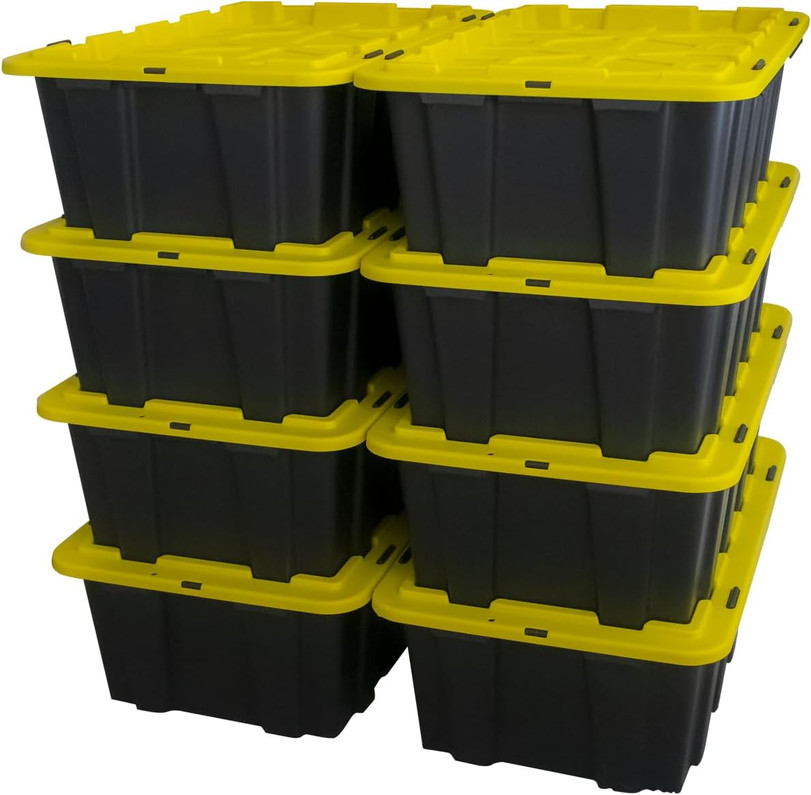
- Snap lid totes. Our 12 gallon snap lid storage bins come in a set of 8 and measure 24.5 x 16.5 x 9 inches. They stack up to 8 levels high, nest inside each other when empty, and have built-in handle grooves for pulling them off high shelves. The listing notes they are designed for garage or workshop storage and are not suited to fabric or consumable products.
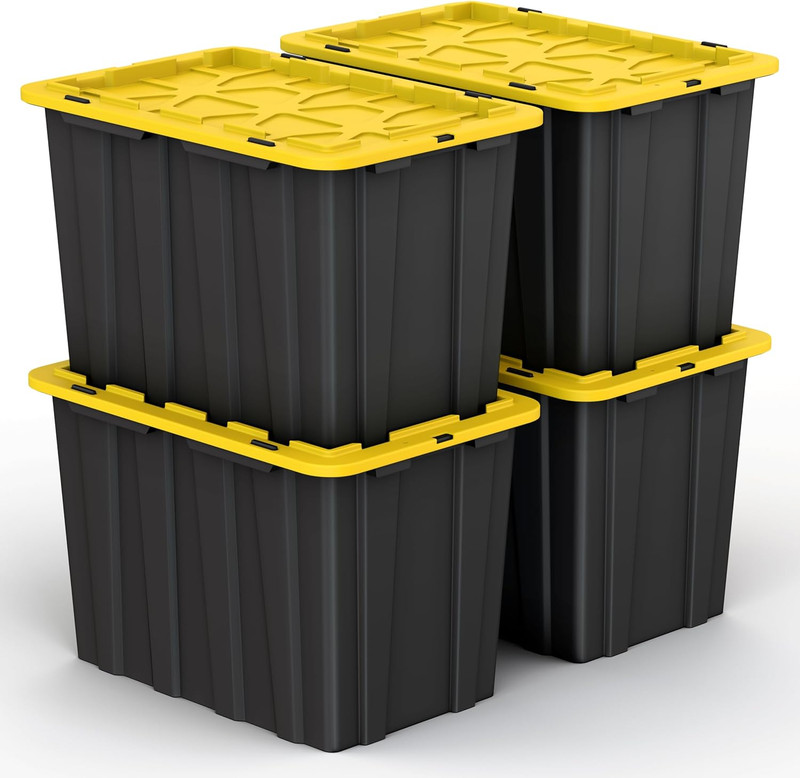
- Industrial totes with latching lids. Our industrial tote 4 pack has black bins with yellow latching lids that lock into place to help keep out dust and liquids. They stack up to 4 levels high and nest when empty.
Both styles have flat, smooth ends that give you a good surface for a label. Check each product page for full details before you plan your shelf layout.
Labeling Tips for Garages, Basements and Attics
- Use bigger text up high. Labels on bins near the ceiling need to be readable from the floor.
- Protect labels from damp air. In a garage or basement, cover paper labels with clear tape so humidity does not curl or smear them.
- Face labels outward every time. Make it a household rule that bins go back on the shelf label side out.
- Stack within the limits. Follow the stacking height listed for your bins, put the heaviest bins on the bottom and keep heavy bins at waist height or lower so you are not lifting them overhead.
- Lift with care. Use the handle grooves, keep the bin close to your body and get help or a cart for heavy loads.
Keeping Your Labeling System Up to Date
A label is only useful if it is accurate. Twice a year, such as when you swap seasonal decorations, open each bin, check the contents against the label and update anything that changed. Retire labels for categories you no longer need and reuse those bins for new ones. If you keep a digital list, update it at the same time.
Frequently Asked Questions
Where is the best place to put a label on a storage bin
Put the main label on the short end that faces out on the shelf, and add a second label on the lid. That way you can read it whether the bin is on a rack or stacked on the floor.
What should I write on a storage bin label
Use a large category title, a short list of the main items inside and, if you have many bins, a location code such as A3 that matches your shelf.
How do I label black plastic bins
White or light printed labels, white paint markers and colored tape all stand out well against dark plastic. Cover paper labels with clear packing tape in garages and basements.
How do I keep bin labels from peeling off
Clean and dry the surface first, press the label firmly from the center outward and cover it with a strip of clear packing tape for extra protection.
Start Your Labeled Storage System
A matching set of bins and a simple labeling routine can make a cluttered garage, basement or closet easy to search. Pick up a set of 12 gallon snap lid bins or industrial totes with latching lids, and explore every size and style in our home storage bins collection.
Recent Posts
-

Folding Tables Versus Workbenches for Real Work
A garage project can change quickly: one day you are assembling shelves, and the next you need the f …Nov 15, 2026 -
Aluminum Versus Steel Ladders for Work and Home
A ladder that is awkward to carry often gets left in the garage. A ladder that is too light-duty for …Nov 14, 2026 -
Office Supply Cart Guide for Smarter Workspaces
A supply closet may hold plenty of inventory, but it does not help much when envelopes, labels, pape …Nov 13, 2026