What Dolly Works Upstairs? Safer Moving Options
A fully loaded box may roll easily across a garage floor, then become difficult the moment it reaches the first step. If you are asking what dolly works upstairs, the honest answer is that no standard wheeled dolly simply rolls up a staircase. The right choice depends on the item, the stairs, the available help, and whether you need to protect walls, treads, and the load itself.
For most household and small-business moving jobs, a stair-climbing hand truck is the best fit for boxed items and many appliances. A traditional appliance hand truck can also work well when used by experienced movers with proper straps and assistance. Platform carts and flat dollies are excellent on level floors, but they should usually stop at the bottom or top of the stairs.
What dolly works upstairs for most loads?
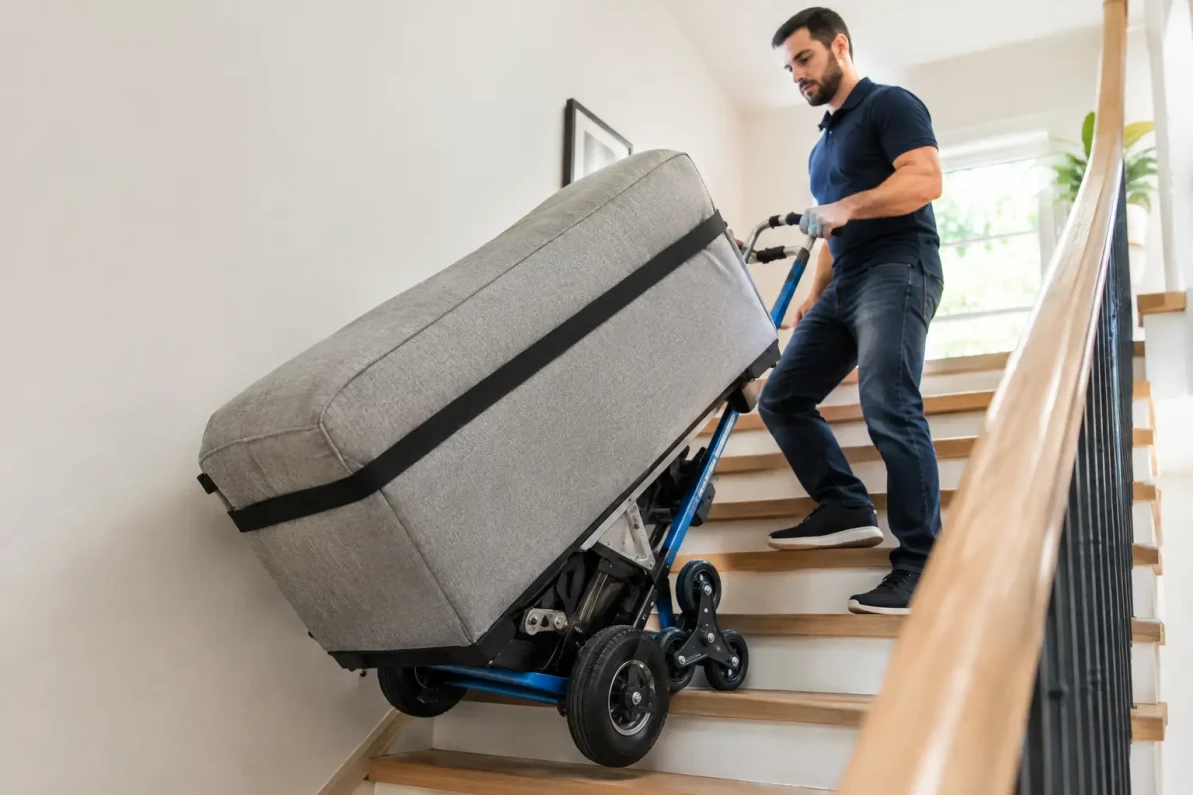
A stair-climbing hand truck is usually the most practical option for stairs. Unlike a basic two-wheel hand truck with round wheels, it uses a rotating wheel assembly, often called a tri-wheel design. As the truck is pulled up or guided down a staircase, the wheels rotate around the step edge rather than requiring one large wheel to be lifted onto every tread.
This design is useful for cartons, storage bins, bundled supplies, office equipment, and compact appliances. It reduces some of the lifting involved, but it does not eliminate the need to control the weight. The operator still has to keep the load balanced, manage each step, and make sure the wheels have enough room to rotate without striking walls or stair edges.
For larger appliances, a heavy-duty appliance hand truck is often the better category. These hand trucks typically have a wider frame, a deeper toe plate, and a securing strap. Some models have stair-climbing wheel assemblies; others rely on conventional wheels and careful handling. Appliance hand trucks are built for bulky loads, but the load rating, wheel type, and stair layout matter more than the name on the product.
Why a platform cart is not the answer on stairs
A platform cart, moving dolly, or furniture dolly is designed to carry a load across a flat surface. Four casters spread the weight well and make it easier to move wide or awkward items through warehouses, hallways, garages, and large rooms. On a staircase, however, those casters cannot climb from one tread to the next.
Trying to drag a platform cart up steps can damage the cart, scrape stair nosing, and make the load unpredictable. The same applies to flat furniture dollies. They are valuable tools for moving a dresser or stack of boxes to the stairway, but they are not stair-moving equipment.
A practical approach is to use two tools: a platform cart on each level and a hand truck for the stairs. This is especially helpful for apartment moves, multi-level homes, storage rooms, and businesses with stock stored on different floors. It also keeps the stair portion of the job focused on a smaller, more controllable load.
Match the dolly to the item you are moving
The best dolly changes with the cargo. A stack of shipping cartons is very different from a washing machine, and neither should be handled like a long piece of furniture.
For boxes, totes, and packaged inventory, choose a stair-climbing hand truck with a toe plate wide enough to support the bottom of the load. Keep the stack narrow enough that you can see around it or have a helper guide you. Heavy boxes should be placed low, with lighter boxes on top.
For refrigerators, washers, dryers, and other large appliances, look for an appliance hand truck with a secure strap and a capacity that exceeds the item’s actual weight. Measure the appliance, stair width, landings, and turns before choosing equipment. A hand truck may have enough rated capacity yet still be a poor fit if the load cannot clear a tight corner or low ceiling.
For furniture, the answer is often not a dolly alone. A hand truck can move narrow, sturdy pieces such as small cabinets or boxed furniture. Sofas, mattresses, large dressers, and fragile pieces may need carrying straps, furniture pads, and at least two people. A wheeled tool is helpful before and after the stairs, but the stair section may need to be handled manually.
Check the stairs before you buy or move
The equipment is only part of the decision. A straight, wide staircase with firm treads is much easier to work on than a narrow stairwell with a turn halfway up. Before moving anything, measure the usable width of the stairs and the landing depth. Include handrails, trim, door frames, and any tight turns in your measurements.
Also consider the stair surface. Carpet can add grip but may make wheels harder to roll. Smooth painted wood, tile, or metal treads can be slick, particularly if they are dusty or wet. Clear loose rugs, tools, packages, and other trip hazards from the route. Good lighting matters because the person controlling the hand truck needs to see each step and landing clearly.
A stair-climbing wheel assembly needs adequate clearance. On very shallow steps, unusually deep steps, or stairs with protruding nosing, the wheel cluster may not rotate as expected. If possible, test the empty hand truck on a few steps before loading it.
Capacity is not the whole story
A dolly’s listed weight capacity is a starting point, not an automatic approval for every moving job. That rating generally assumes a balanced load and appropriate use on suitable surfaces. Stairs introduce shifting weight, angled handling, impact at each step, and more demand on the operator.
Choose a cart or hand truck with capacity above the expected load, but do not load it to the limit simply because the label allows it. A lighter, stable load moved in two trips is usually easier to control than one oversized stack. This is particularly true on narrow stairs, where there is little room to correct the load if it begins to lean.
Pay attention to the toe plate as well. A deep toe plate supports larger boxes and appliance bases more securely. A small toe plate may be fine for compact cartons but can allow a larger item to tilt or shift. For appliances and tall items, straps are just as important as the frame and wheels.
Use the right technique with a stair hand truck
Load the heaviest portion of the item nearest the hand truck frame. Center the weight from side to side, and use a strap when the item could slide, tip, or separate from the truck. Avoid stacking boxes so high that they block your route or create a top-heavy load.
For an upstairs move, keep the hand truck under control at every step rather than trying to gain momentum. A helper can guide the top of the load, call out clearances, and help steady the item at landings. The person in the better position to control the load should direct the movement, and both people should agree on each step before starting.
Do not use a hand truck on stairs if you cannot maintain a secure grip, see the route, or safely turn at the landing. If an item is too heavy, too large, or too fragile for the stairway, break down the load, remove drawers or detachable parts when appropriate, or use a different moving plan. Protecting the item is useful, but controlling the move comes first.
A simple buying checklist
When shopping for a dolly that will be used near stairs, compare the hand truck’s rated capacity, frame material, toe plate dimensions, wheel design, and overall size. For regular stair use, stair-climbing wheels are worth prioritizing. For appliances, a securing strap and a frame made for larger loads are more important than a compact folding design.
Folding hand trucks are convenient for light boxes and occasional storage, but they are not always the best choice for repeated heavy stair work. A full-size steel hand truck may take up more storage space, yet it can provide better support for demanding jobs. For level-floor work, add a platform cart or furniture dolly rather than expecting one product to do every task.
Easy Deal USA customers often get the best value by matching the equipment to the route: a hand truck for vertical movement and a platform cart for long, level distances. That combination can make moving supplies, inventory, storage bins, and household goods more efficient without forcing the wrong cart onto a staircase.
The right upstairs dolly is the one that fits both the load and the stairs. Measure first, choose a stair-capable hand truck when wheels are needed on steps, and keep platform carts where they perform best: on flat ground.
Recent Posts
-
Frigidaire Fridge Door Shelf Rail Broken: Replace 240534901
If the door shelf rail on your Frigidaire refrigerator has cracked, snapped off or keeps popping loo …Nov 21, 2026 -

Storage Totes for Contractors: Truck and Jobsite Guide
Every contractor knows the cost of a disorganized truck. You drive to the job, then spend twenty min …Nov 21, 2026 -
How to Pack a Heavy Box for Shipping Without Blowouts
A heavy box fails in predictable ways. The bottom seam splits when someone lifts it, a corner crushe …Nov 21, 2026