
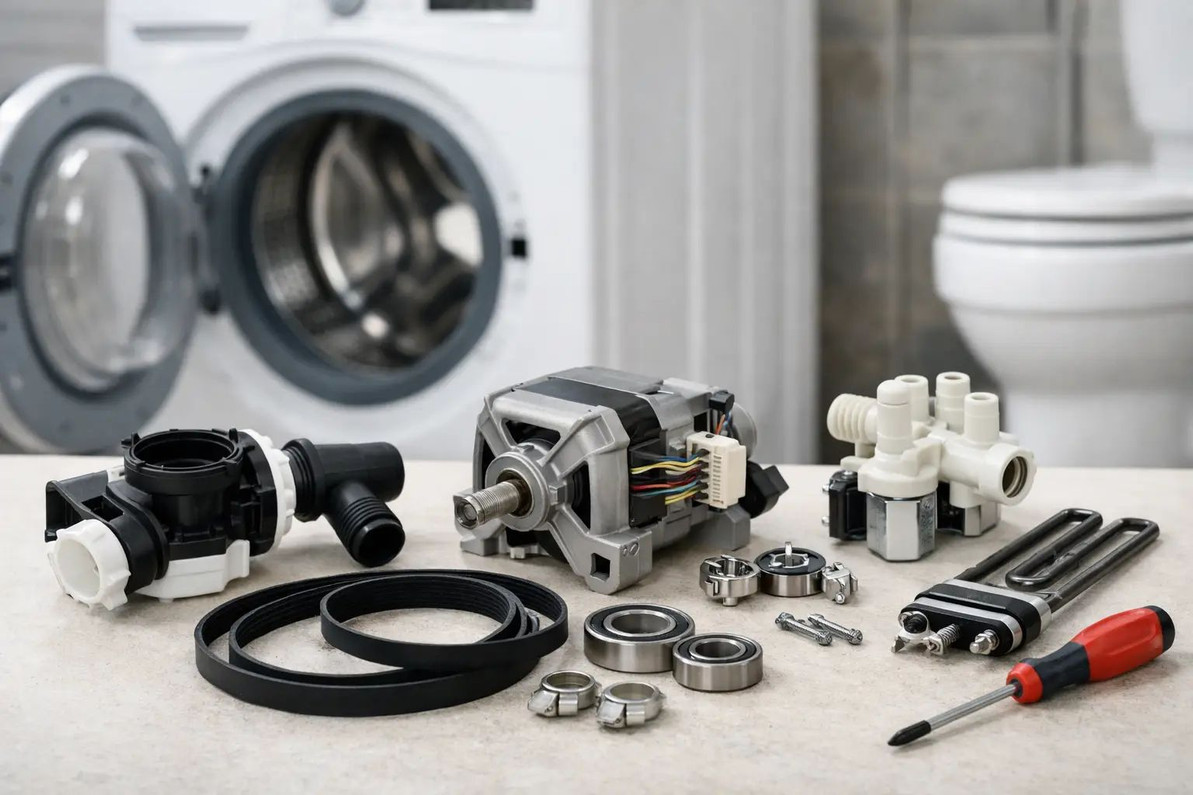
Washer Repair Parts Guide for the Right Fix
A washer that will not drain, spin, fill, or stay balanced can disrupt a household, rental unit, or laundry operation quickly. This washer repair parts guide helps you narrow down the cause before ordering, so you can avoid buying a part that looks right but does not fit your machine.
The best repair starts with the model number, not the symptom alone. Many washer parts vary by brand, model series, production date, and even color or connector style. A little verification up front can save the time and cost of a return later.
Start With the Washer Model Number
Find the appliance model number before searching for any replacement part. It is commonly printed on a label under the lid, around the door opening on front-load washers, on the rear panel, or near the control console. Take a clear photo of the full label. It may include a serial number, which can help identify production-specific versions of a part.
Use the complete model number when checking compatibility. Leaving out a few letters or numbers can lead to a mismatch, especially for door locks, control boards, water inlet valves, and lid switches. If a listing provides compatible model numbers or an OEM-style part number, compare every character against your washer information.
Before taking anything apart, unplug the washer. Turn off the hot and cold water supply valves if the repair involves hoses, the water inlet valve, pump, or other water-carrying components. Keep towels and a shallow pan nearby when working around the drain system, since residual water is normal.
Match the Symptom to the Likely Washer Repair Part
A symptom gives you a starting point, but it does not always point to one failed component. For example, a washer that will not spin may have a worn drive belt, a faulty lid switch, a damaged door lock, an overloaded tub, or a drainage problem preventing the spin cycle from starting.
Washer Will Not Fill or Fills Slowly
Start with the simplest checks. Confirm both supply valves are fully open and inspect the fill hoses for kinks. Small mesh screens at the water inlet can collect sediment over time. If water pressure is normal and the screens are clear, the water inlet valve may be the issue.
A water inlet valve controls the flow of hot and cold water into the tub. Choose a replacement with the same mounting arrangement, hose connections, electrical terminals, and part number application. Do not assume a valve that fits physically will operate correctly with your washer's controls.
Washer Will Not Drain
Drainage problems often come from a blocked drain hose, clogged pump filter, or small item caught in the drain pump. Coins, fabric, hair ties, and small clothing items can obstruct the pump impeller. Check accessible filters and hoses first.
If the pump makes a loud humming sound but water remains in the tub, the impeller may be blocked or damaged. If the pump leaks, has a cracked housing, or does not run after power and wiring have been checked, replacing the drain pump is often the practical repair. Confirm the inlet and outlet port positions, mounting tabs, and wire connector before ordering.
Washer Will Not Spin or Agitate
Top-load and front-load washers use different drive systems, so the right part depends on the machine. A belt-driven washer may need a replacement belt if the existing belt is frayed, cracked, loose, or has slipped off the pulley. A direct-drive model may instead use a motor coupler, clutch component, shift actuator, or other model-specific drive part.
For a top-load washer, a failed lid switch can stop spinning because the machine cannot verify that the lid is closed. On a front-load model, the equivalent issue may be a door lock or door latch assembly. If the door does not lock, the display shows a door-related error, or the cycle pauses before spinning, inspect the latch area and strike for damage before replacing the lock assembly.
Washer Leaks Water
The location of a leak matters. Water at the rear may point to fill hoses or the inlet valve. Water near the front of a front-load washer can indicate a worn or torn door boot seal. Water underneath can come from the drain pump, tub-to-pump hose, dispenser hose, or internal tub seal.
Do not order a door boot based only on the washer brand. The shape, drain openings, clamp channels, and dispenser connection must match the model. When replacing a rubber seal or hose, inspect the clamps too. Reusing a bent, corroded, or weakened clamp can turn a good repair into another leak.
Washer Is Loud, Shakes, or Walks
First, make sure the washer is level and sitting firmly on the floor. An uneven load, such as one heavy item, can also cause severe vibration. If the noise continues with balanced loads and a level machine, inspect suspension rods, shock absorbers, springs, tub bearings, or leveling feet depending on the washer design.
A rumbling or grinding sound during spin can suggest bearing wear, particularly if the inner basket has noticeable play. Bearing repairs can be more involved than replacing a pump or switch. Consider the machine's age, the cost of the repair parts, and the labor required before deciding whether a repair makes sense.
Check Part Details Before You Buy
A dependable replacement part is more than a similar-looking component. Review the listing for the manufacturer part number, compatible models, dimensions when provided, connector count, mounting holes, and package contents. Some parts are sold as an assembly, while others include only one piece of a larger system.
This is especially important for these commonly confused parts:
- Door locks and lid switches may have different wire connectors or mounting positions.
- Drain pumps may use different port angles, motor ratings, or mounting bases.
- Belts can look nearly identical while differing in length, width, rib count, or profile.
- Water valves can have different terminal layouts and hose connection locations.
- Door seals and gaskets can vary by clamp groove and dispenser opening.
When possible, compare the old part's printed number with the replacement listing. If the original number has been replaced by a newer manufacturer number, confirm that the listing specifically identifies it as a substitute. A compatible aftermarket part can be a value-focused option when its fitment details match your model, while an OEM replacement may be preferred for highly specific electronic or molded components. The right choice depends on availability, price, and the level of compatibility information provided.
Know When a Repair Is DIY-Friendly
Many washer repairs are manageable for an experienced DIY customer with basic hand tools. Replacing fill hoses, a drain hose, a door strike, leveling feet, pump filter, or an accessible lid switch may be straightforward when instructions and access are clear.
Other repairs deserve more caution. Control boards, motor wiring, capacitor-related components, bearings, and major tub repairs can require diagnosis beyond a visible inspection. If there are burned connectors, repeated breaker trips, a burning smell, damaged wiring, or a suspected electrical fault, stop using the washer and consider qualified appliance service.
Take photos before disconnecting wires, hoses, springs, or clamps. Labeling connections with tape is a simple way to prevent installation mistakes. After reassembly, run a short rinse or test cycle while watching for leaks and unusual noises. Keep the rear access area open until you confirm the repair is successful.
Keep a Few Wear Items in Mind
For landlords, property managers, and maintenance teams, keeping common model-specific washer parts available can reduce downtime. Drain pumps, inlet valves, belts, lid switches, door strikes, and hose clamps are frequent repair items, but stocking only verified compatible parts is usually more useful than keeping a random assortment.
For one-time home repairs, order based on the confirmed failure rather than replacing multiple parts at once. A washer may be old, but replacing parts without diagnosis can cost more than a targeted repair. Easy Deal USA focuses on practical appliance replacement parts and clear compatibility details to help shoppers choose with less guesswork.
A successful washer repair is usually not about finding the fastest-looking part. It is about confirming the model, tracing the symptom to the most likely component, and checking the details that determine fit. That careful approach gets your laundry routine back on track with fewer delays and fewer wrong orders.
Recent Posts
-
Foam Play Mat Setup Guide for Babies and Toddlers
Once a baby starts rolling, scooting and crawling, the floor becomes the main play area, and hard fl …Oct 24, 2026 -
Folding Table as a Desk: Home Office Setup Guide
Not every home has room for a permanent desk, and not every work-from-home setup needs one. Using a …Oct 24, 2026 -
Duct Tape vs Packing Tape: Which to Use and When
You are halfway through packing a stack of boxes and the packing tape runs out, but there is a roll …Oct 24, 2026
