Platform Dollies: How to Choose the Right One
A stack of boxes is easy to move until it has to cross a parking lot, fit through a stockroom doorway, or make the trip from a delivery vehicle to a storage shelf. Platform dollies turn those repeated carrying jobs into a manageable rolling task. The right model can save time during moves, receiving, order packing, maintenance work, and everyday storage projects - but only if its size, capacity, and wheels match the job.
What Is a Platform Dolly?
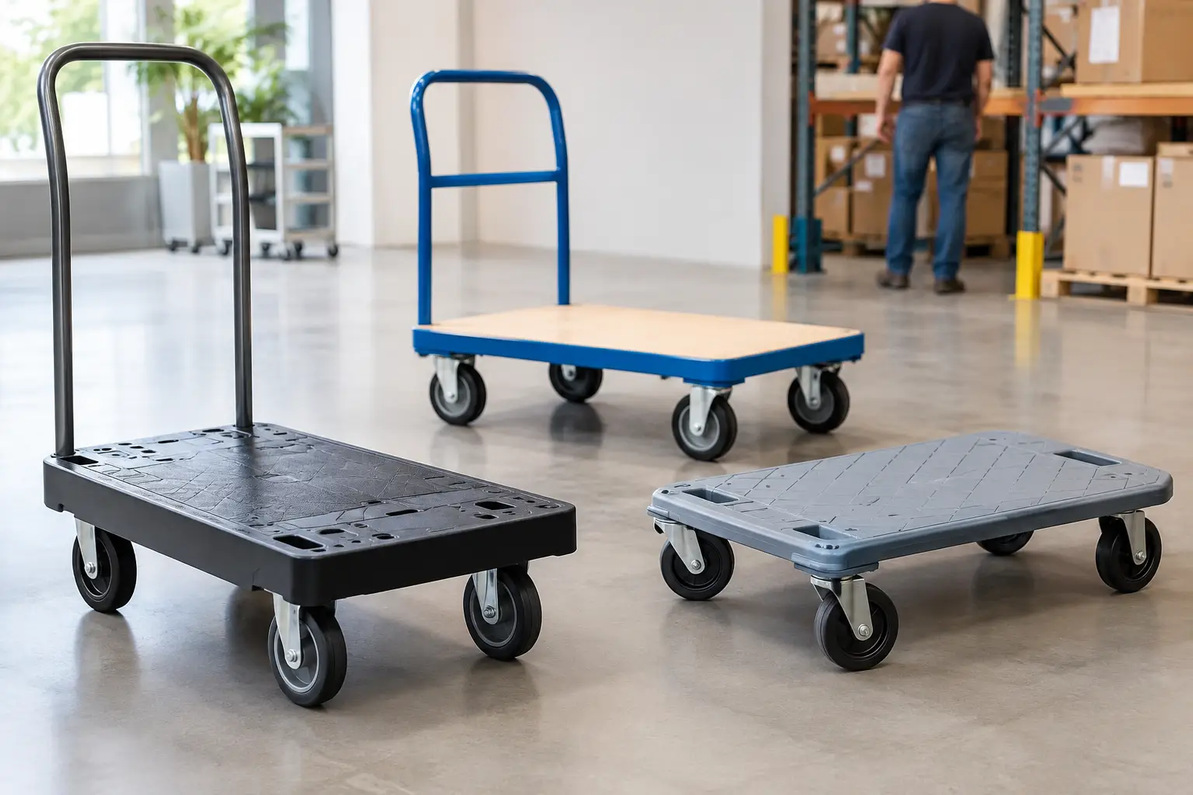
A platform dolly is a flat, wheeled cart designed to carry loads that are too bulky, heavy, or awkward to carry by hand. Most models have a broad deck and an upright push handle. Folding-handle versions store more easily, while fixed-handle models are often a practical choice for carts that stay on the warehouse floor, in a retail back room, or at a dedicated workstation.
Platform dollies are different from upright hand trucks. A hand truck supports a load vertically and is useful for tall, narrow items such as cartons, appliances, or stacked cases. A platform dolly supports the entire load from underneath. That makes it especially useful for wide boxes, storage totes, office supplies, equipment, folding tables, and multiple packages moving at once.
For many homeowners and small businesses, the main benefit is not simply moving more weight. It is reducing the number of trips. One well-loaded cart can move a shipment, a supply run, or several storage bins in a single pass.
Start With the Load, Not the Cart
The most common buying mistake is choosing a platform dolly based only on its listed weight capacity. Capacity matters, but it is only one part of the decision. Think about what you move most often, where it starts and ends, and how much room you have to turn the cart.
Measure the footprint of your typical load. A deck that is too short or too narrow may still hold the stated weight, but overhanging boxes are harder to control and more likely to shift. For moving standard cartons, a compact deck may be enough. For large storage totes, bulk supplies, or long equipment cases, a longer and wider platform provides better support.
Also consider the load's shape. Low, evenly stacked boxes are easier to move than tall, top-heavy loads. If you regularly transport tall stacks, choose a deck that gives the load a stable base and plan to secure it with appropriate straps when needed. A cart cannot correct for an unstable stack.
Weight capacity should include the full load, not an estimate based on one box. Add up all cartons, packaging, and equipment placed on the deck. It is wise to leave room below the cart's maximum rating rather than operating at the limit every day. This helps keep the cart easier to steer and reduces stress on the wheels and frame.
Choose Deck Material for the Work Area
Platform decks are commonly made from steel, plastic, wood, or a combination of materials. There is no single best choice because the work environment changes the answer.
Steel deck dollies are a practical option for demanding commercial use and frequent movement of dense loads. They are often chosen for stockrooms, workshops, receiving areas, and maintenance departments where carts see regular use. Look for a textured or non-slip deck surface when boxes or containers may slide during turns.
Plastic deck dollies are often lighter and can be easier to handle for home storage, office use, classrooms, and light business tasks. They are a sensible choice when corrosion resistance, easy cleanup, and low cart weight are priorities. The trade-off is that the deck size and capacity may be more limited than on heavy-duty steel models.
Wood platform dollies can offer a simple, durable surface for general moving and storage work. They are commonly used indoors on smooth floors. If the cart may encounter moisture, outdoor exposure, or frequent spills, a material that is easier to wipe down may be more convenient.
Wheels Decide How the Dolly Feels in Use
A platform dolly can have the right deck and capacity yet still be frustrating if the wheels do not suit the floor. Wheel type affects rolling resistance, noise, maneuverability, and how well the cart handles thresholds or rough pavement.
Hard wheels generally roll efficiently on smooth concrete, tile, and warehouse floors. They can be a good fit for indoor routes with clean, level surfaces. Softer rubber or pneumatic-style wheels may handle uneven ground, cracks, and outdoor routes more comfortably, though they can require more attention over time depending on the design.
Caster layout matters too. Four swivel casters make tight turns easier, which is useful in narrow aisles, storage rooms, and crowded retail spaces. Two fixed wheels paired with two swivel casters can provide more directional control for longer straight runs. Neither arrangement is automatically better. A warehouse worker moving cartons down long aisles may prefer predictable tracking, while a property manager navigating around doors and furniture may value tighter maneuverability.
Pay attention to wheel diameter. Larger wheels generally roll over small obstacles and doorway thresholds more easily than smaller wheels. If the route includes elevator gaps, sidewalk joints, loading areas, or rough concrete, this detail can make a noticeable difference.
Folding Handle or Fixed Handle?
A folding handle makes a platform dolly easier to store in a closet, vehicle, supply room, or utility area. It is a strong choice for homeowners, mobile maintenance crews, online sellers, and businesses that bring equipment to different job sites. When folded, the cart can often slide beside shelving or fit under a workbench.
A fixed handle is simpler and always ready to use. For a cart assigned to a packing station, warehouse aisle, or receiving dock, storage may not matter as much as quick access. Fixed handles can also be useful when the dolly is used constantly throughout the day.
Before buying, check the overall dimensions with the handle folded and unfolded. This is especially important for vehicle storage and small utility closets. A cart that works well on the floor is less useful if it does not fit where you need to keep it.
Practical Features That Are Worth Checking
Small construction details can affect day-to-day convenience. A non-slip deck helps boxes stay in place. Raised edges or corner bumpers can reduce contact between the cart and nearby walls or fixtures. A handle with a comfortable grip is helpful when the cart is pushed repeatedly during a shift.
For commercial environments, consider whether replacement wheels or parts are available for the style of cart you choose. High-use dollies eventually need attention, particularly when they travel over rough surfaces or carry heavy loads. Buying a practical, serviceable design can be more useful than choosing a cart with features you will not use.
If several people will use the same cart, select a model that is straightforward to operate. The best dolly for a shared workplace is often one with clear capacity information, easy rolling action, and dimensions that fit common loads without special handling.
Safe Loading Makes the Cart More Useful
Platform dollies reduce carrying, but they still require good loading habits. Place heavier items low and centered over the deck. Keep the load balanced from side to side, and avoid stacking cartons so high that you cannot see where you are going. Push the cart whenever possible instead of pulling it behind you, especially in busy work areas where you need a clear view ahead.
Slow down at thresholds, ramps, and turns. A load that is stable on a straight, smooth floor can shift quickly when one wheel catches an edge. Keep hands and feet clear when lowering the handle or positioning a loaded cart, and do not use a platform dolly as a step or ride-on cart.
When moving long or oversized items, make sure the path is clear before loading. Check door widths, elevator openings, and turning points. A few minutes spent measuring the route can prevent a stalled move with a fully loaded cart.
A Good Dolly Should Fit Your Routine
The best platform dolly is the one that solves your repeated moving problem without taking up unnecessary space or adding extra effort. For occasional home use, a compact folding model may be the practical answer. For shipping stations, retail stockrooms, warehouses, and maintenance teams, a larger deck, dependable wheels, and a capacity suited to daily loads may be worth prioritizing.
Before placing an order, compare deck dimensions, handle style, wheel configuration, and stated capacity against the loads and routes you handle most. A well-matched cart becomes one of those simple tools you reach for constantly - whether you are moving one bulky item or keeping an entire workday on track.
Recent Posts
-
How to Organize Toys With Clear Storage Bins
Toy clutter tends to peak right before the holidays, when birthday gifts from the year are still sca …Oct 23, 2026 -
Folding Chairs for Church Halls and Community Centers
Church halls, fellowship rooms and community centers ask more of their seating than almost any home. …Oct 23, 2026 -
Restaurant Bus Cart Guide: Using a Utility Cart for Bussing
Every busy dining room hits the same wall at some point in a shift: dirty plates stack up, servers m …Oct 23, 2026