Platform Cart Versus Hand Truck for Your Load
A stack of shipping boxes, a new appliance in the garage, or supplies headed across a stockroom can turn into a frustrating job when the wrong mover is involved. In the platform cart versus hand truck decision, the best choice comes down to how the load sits, how far it must travel, and whether you need to stack it upright or roll it flat.
Both tools reduce lifting and help protect floors, products, and backs when used correctly. But they handle weight in very different ways. A hand truck is designed to slide under a load and tilt it back. A platform cart carries the load on a flat deck, giving you more room for awkward, wide, or unstable items.
Platform Cart Versus Hand Truck: The Main Difference
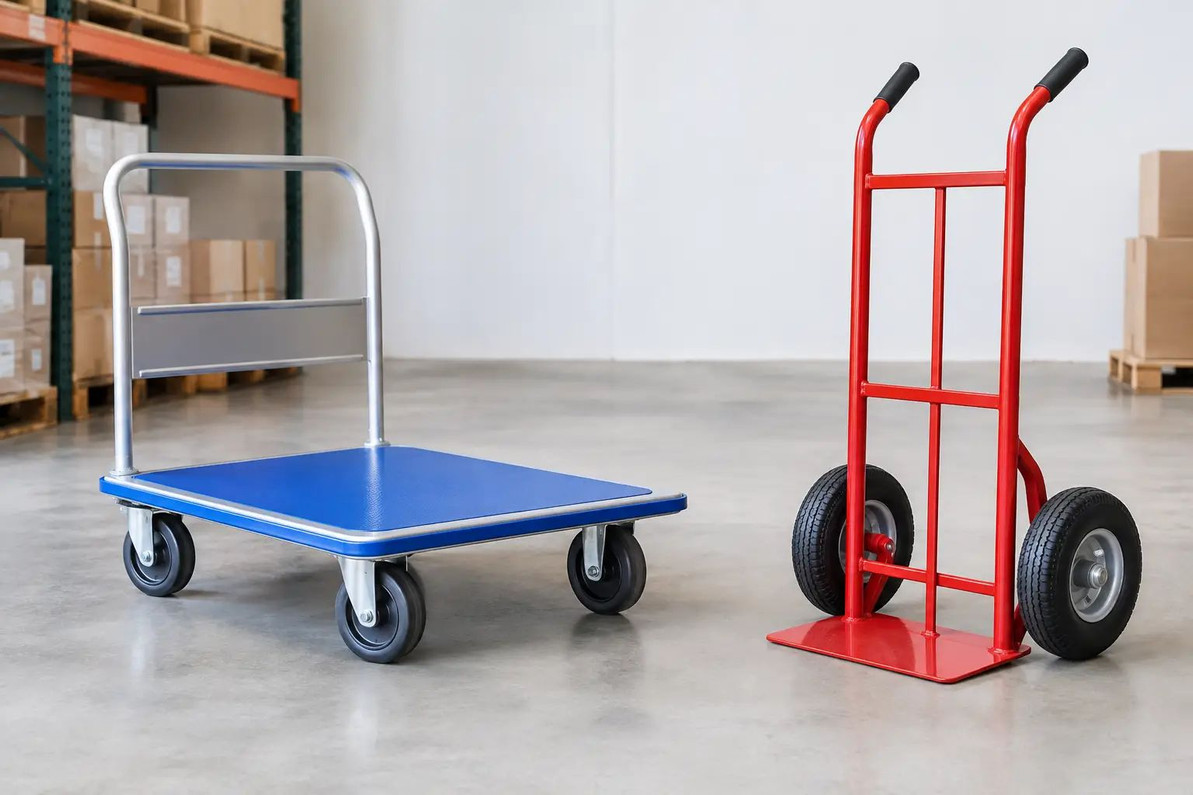
A hand truck, also called an upright dolly, has a small toe plate at the bottom, two main wheels, and a tall handle frame. You place the toe plate under a box, appliance, or stack of cartons, secure the load if needed, then tilt the frame toward you and roll. The wheels carry the weight while you guide the angled load.
A platform cart has a low, flat platform supported by four casters or wheels. You load items onto the deck and push or pull the cart along a level path. Many models have a fixed, folding, or removable handle to make storage and loading easier.
That basic design difference shapes nearly every buying decision. Hand trucks are usually better for tall, compact loads and routes with curbs, steps, or uneven transitions. Platform carts are generally better for multiple boxes, oversized items, and loads that should remain level.
When a Hand Truck Is the Better Choice
Choose a hand truck when you regularly move individual heavy items that are taller than they are wide. It is a practical option for delivery work, apartment moves, maintenance tasks, and storage areas where a full-size cart may be difficult to turn.
A hand truck works especially well for boxed appliances, water cases, bundled flooring, tall cartons, and stacked moving boxes. Because the load is tilted back, the footprint stays relatively narrow. That matters in hallways, between shelving, through doorways, and in the back of a work vehicle.
Stairs are another reason many customers keep a hand truck on hand. A standard two-wheel model can help move loads over small thresholds and curbs, although stairs still require careful handling and a load that is properly secured. Specialty stair-climbing designs may be useful for frequent stair work, but they are not a substitute for safe lifting practices or adequate help with exceptionally heavy items.
The trade-off is that your load needs a stable, flat bottom that fits the toe plate. A wide plastic tote, a loose pile of supplies, or a long countertop box may be difficult to balance. If the item cannot be tilted safely, a hand truck is not the right tool.
Hand Truck Features That Matter
Start with the toe plate. A larger toe plate supports bigger cartons and reduces the chance that a load will shift off the front edge. Measure the base of the items you move most often instead of assuming every dolly will fit.
Wheel type affects where the hand truck performs best. Pneumatic-style wheels can provide more cushioning over rough outdoor surfaces, while solid rubber or non-marking wheels are often convenient for indoor floors because they require less maintenance. Check wheel diameter as well. Larger wheels generally handle cracks, thresholds, and uneven pavement more easily.
Also consider the frame material, handle shape, and listed weight capacity. Capacity should cover your typical load with room to spare, but it should never be treated as permission to move a load you cannot control safely.
When a Platform Cart Makes More Sense
A platform cart is often the easier choice when you are moving several items at once. Instead of balancing and tilting each carton, you can arrange boxes across the deck, keep them level, and roll them together. For e-commerce packing areas, offices, schools, warehouses, property maintenance, and home projects, that can save repeated trips.
Platform carts are also useful for bulky items with an awkward shape. Think storage bins, folded tables, cleaning supplies, cases of paper, small equipment, plants, toolboxes, or multiple packages headed to the same room. The flat deck supports the item from below rather than relying on a small toe plate.
A four-wheel cart is usually easier to control on smooth, level surfaces. It does not need to be balanced on two wheels, which can make loading and unloading more comfortable for routine tasks. A low deck also means you may not need to raise items as high as you would when stacking them on a hand truck.
The limitation is maneuverability in tight spaces. Platform carts need room for their full deck and wheelbase, and they are not designed to carry a loaded cart up stairs. If your route includes narrow turns, steep ramps, or several steps, measure and plan before choosing a cart.
Platform Cart Features That Matter
Check the usable deck dimensions, not just the overall cart size. The deck should accommodate the width and length of your common loads without forcing boxes to overhang excessively. A larger platform lets you carry more, but it also takes more storage space and may be harder to maneuver through tight aisles.
Caster configuration matters, too. Swivel casters help with turns, while fixed wheels can improve straight-line tracking. Some carts combine both. For warehouses, retail stockrooms, and smooth indoor flooring, non-marking casters can help keep surfaces cleaner. For rougher routes, look for wheels suited to the surface rather than focusing only on the cart's rated capacity.
A folding handle is a useful feature when the cart must fit in a closet, vehicle, maintenance room, or crowded storage area. If you expect to use the cart for large or stacked loads, a fixed handle may feel more substantial. Consider how often it will be stored versus how often it will be used.
Compare the Load Before You Compare the Price
The lowest-priced option is not always the best value if it creates extra trips or cannot handle the job safely. Before buying, picture one normal workday or project. What are you moving? How much does it weigh? What is the largest item? Are the floors smooth, rough, carpeted, or outdoors? Does the route include stairs, thresholds, elevators, or narrow doors?
A hand truck is usually the more efficient answer when the work involves one tall load at a time and the path is tight. A platform cart is usually the better value when the job involves several boxes, wide equipment, or supplies that need to stay flat.
For some homes and businesses, owning both is practical rather than redundant. A property manager might use a platform cart for moving maintenance supplies across a building and a hand truck for appliance boxes or deliveries. A small online seller may use a cart to take packed orders to a shipping station, then use a hand truck to unload incoming cartons from a vehicle.
Capacity Is Only Part of Safe Use
Do not choose material-handling equipment based on capacity alone. The listed capacity reflects the equipment under intended conditions, but real-world control depends on load size, weight distribution, wheel condition, slope, and surface.
Keep the heaviest items low and centered. On a platform cart, distribute weight across the deck and avoid building a tall, unstable stack. Use straps or bungee cords when appropriate for loose or tall loads, especially when crossing thresholds. On a hand truck, position the load against the frame, keep it balanced over the wheels, and make sure the toe plate is fully underneath the item.
Inspect wheels, casters, fasteners, and handles before regular use. A damaged wheel can make a manageable load difficult to steer. Clear the route first, keep hands and feet away from pinch points, and get help when the load is too large to control comfortably.
A Quick Buying Decision
If you need to move stacked boxes, appliances, or tall cartons through narrow paths, start with a hand truck. If you need to transport multiple packages, storage totes, tools, or broad items over level floors, start with a platform cart.
For buyers comparing capacity, dimensions, wheel type, and storage needs, the most useful question is simple: which tool keeps your usual load stable from pickup to destination? Choose that tool, verify the measurements, and moving everyday supplies becomes a much more manageable part of the job.
Recent Posts
-
Foam Play Mat Setup Guide for Babies and Toddlers
Once a baby starts rolling, scooting and crawling, the floor becomes the main play area, and hard fl …Oct 24, 2026 -
Folding Table as a Desk: Home Office Setup Guide
Not every home has room for a permanent desk, and not every work-from-home setup needs one. Using a …Oct 24, 2026 -
Duct Tape vs Packing Tape: Which to Use and When
You are halfway through packing a stack of boxes and the packing tape runs out, but there is a roll …Oct 24, 2026