Kitchen Drawer Organizer Guide for a Better Fit
A drawer that jams because a spatula is sitting sideways is not a storage problem you solve by buying the biggest organizer available. It is usually a fit problem. This kitchen drawer organizer guide helps you measure what you have, decide what deserves drawer space, and choose organizers that make everyday cooking and cleanup faster.
The best setup is rarely the most elaborate one. A shallow drawer near the range may only need dividers for cooking tools. A wide drawer can hold flatware, serving pieces, or food-storage accessories. Start with how the drawer is used, then select an organizer that fits its interior dimensions and the items you reach for most.
Start With the Drawer, Not the Organizer
Kitchen drawers vary more than they appear to from the outside. Cabinet face dimensions do not tell you the usable space inside. Drawer slides, side walls, and hardware can take away valuable room, especially in older cabinets or rental kitchens.
Empty the drawer and measure its interior width, depth, and height. Measure at the narrowest points, not just at the front opening. For width and depth, leave a small amount of clearance so trays do not bind against the drawer sides. For height, measure from the drawer bottom to the lowest point of the cabinet or countertop above when the drawer closes.
Also check for obstructions. A center divider, plumbing beneath a sink, or a drawer that tapers toward the back can change which organizer will work. If you are buying a multi-piece tray system, write down the dimensions of each drawer before shopping. This simple step prevents the common mistake of receiving an organizer that is close, but not usable.
A practical measuring checklist
Before choosing any drawer insert, confirm these four details:
- Interior width at the front, center, and back
- Interior depth from the inside front wall to the back wall
- Usable height with the drawer fully closed
- Clearance around slides, hinges, dividers, or plumbing
For a drawer that is not perfectly square, use the smallest measurement. A tray with extra open space around it is far more useful than one that must be forced into place.
Choose a Kitchen Drawer Organizer by Use
The right organizer depends on the items going into it. Flatware, knives, utensils, wraps, and food containers each need a different type of compartment. Trying to store everything in one deep, divided tray often creates more clutter than it removes.
Flatware and everyday utensils
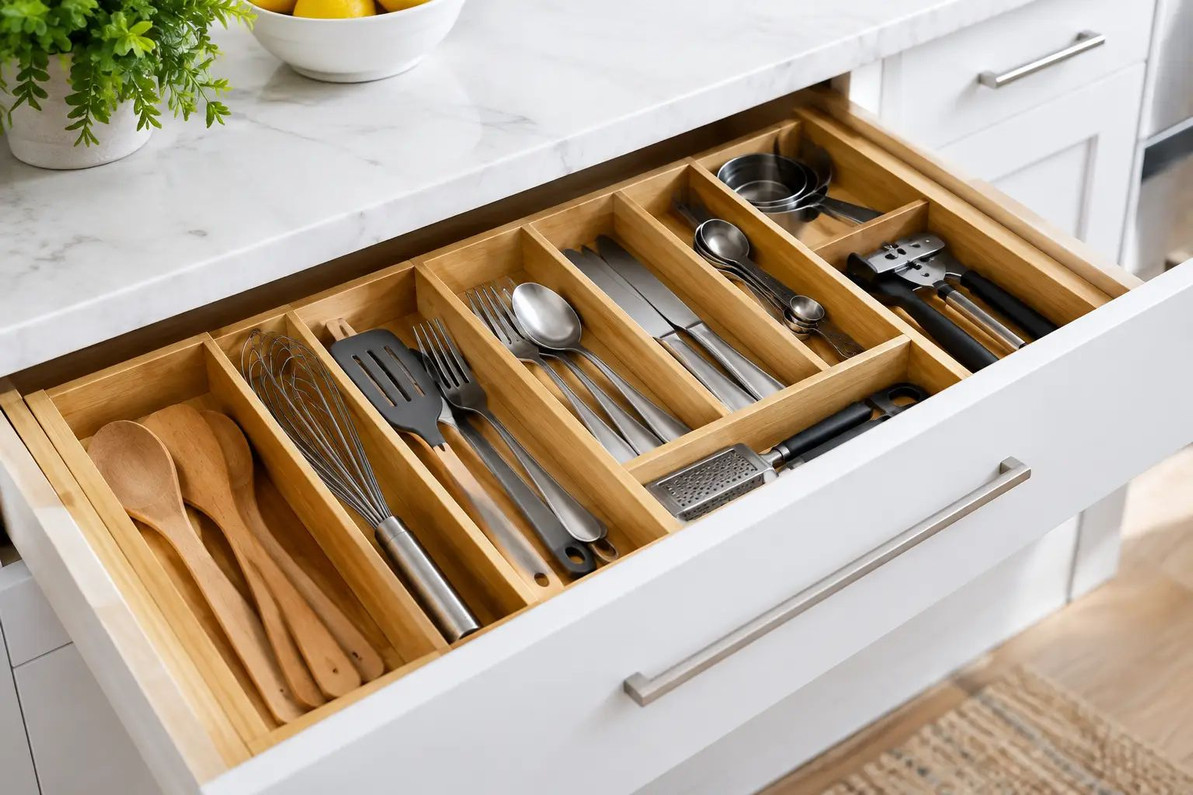
A standard flatware tray works well for forks, knives, spoons, and a few serving utensils. Look for compartments long enough for your largest everyday pieces, not only the teaspoons. Expandable organizers can be useful for wide drawers, but measure carefully at both their closed and expanded widths.
For a household that uses oversized steak knives, chopsticks, or long-handled iced-tea spoons, a simple tray with fewer, wider sections may be better than a tightly divided model. More compartments are not always better if they make items difficult to remove.
Cooking tools
Drawers near the stove are best for turners, whisks, tongs, ladles, measuring tools, and can openers. Adjustable dividers are often a good choice here because cooking tools come in irregular sizes. They let you create one long section for spatulas and tongs, plus smaller sections for peelers, thermometers, or measuring spoons.
Keep only the tools you use regularly in this drawer. Duplicate utensils, seasonal baking items, and specialty gadgets can move to a secondary drawer or storage bin. The goal is not to display every tool you own. It is to make the next meal easier to prepare.
Knives and sharp tools
Loose knives should not sit in an open drawer with other utensils. A dedicated knife organizer keeps blades separated and prevents them from sliding when the drawer opens. Choose a low-profile option that allows the drawer to close without touching the blades or handles.
If you include kitchen shears, peelers, or a pizza cutter in the same area, make sure each item has a stable compartment. Do not overfill a knife tray. Crowded storage makes it harder to safely remove what you need.
Food-storage bags, foil, and wraps
Wide, shallow drawers can be useful for boxes of plastic wrap, aluminum foil, parchment paper, sandwich bags, and trash bags. A dedicated organizer can keep boxes from sliding and help separate different bag sizes. This arrangement works especially well in drawers near a prep counter or refrigerator.
Check box dimensions first. Some organizers are designed around common box sizes, but oversized rolls and bulk packages may not fit. If your household buys larger packages to save money, adjustable dividers may offer more flexibility than a fixed insert.
Containers, lids, and accessories
Food-storage containers are often better in a cabinet or deep pullout, but a deep drawer can work if you store lids vertically and nest containers by size. Use dividers to keep lids from drifting into one pile. Small bins can hold clips, reusable straws, bag seals, and other loose accessories.
A deep drawer is tempting as a catch-all, but it benefits from structure just as much as a shallow one. Without dividers or bins, the bottom layer becomes inaccessible and useful items disappear under larger pieces.
Fixed Trays, Expandable Inserts, or Adjustable Dividers?
Fixed trays are straightforward and usually the quickest option for standard utensil drawers. They are a good value when the drawer is a predictable size and you already know what will go inside. Their trade-off is limited flexibility. If you change the drawer's purpose later, the compartments may no longer suit your items.
Expandable inserts are useful when you need to use extra width without leaving gaps along the sides. They can create a more finished look and add compartments for serving pieces. However, the expanded sections may be narrower than expected, so they are best for smaller utensils rather than bulky tools.
Adjustable dividers offer the most customization. They work well for cookware tools, wraps, lids, and drawers with uncommon dimensions. They do require more setup, and loose dividers can shift if they are not designed to grip the drawer securely. For many kitchens, a combination works best: a flatware tray in one drawer and adjustable dividers in another.
Material Matters for Daily Use
Plastic organizers are lightweight, easy to wipe clean, and often available in many sizes. They are practical for busy family kitchens, rentals, and utility spaces. Clear plastic makes it easy to see crumbs and spills, while solid-color trays can give the drawer a cleaner visual look.
Bamboo and wood organizers provide a warmer appearance and can feel more substantial in a frequently used drawer. They should be kept dry and cleaned according to the material's care instructions. A wood tray may be less forgiving than plastic in a drawer with moisture or frequent spills.
Metal organizers can be durable and easy to clean, but check the edges and feet. A tray that slides can scratch the drawer bottom or become annoying each time you open it. Non-slip pads or liners can help keep organizers in place regardless of material.
Build Zones That Match Your Kitchen Routine
Organize drawers by task instead of by item type alone. Put cooking tools near the range, prep tools near the main work surface, and food-storage supplies near the refrigerator or cleanup area. This reduces unnecessary steps and makes it easier for more than one person to put items back where they belong.
A small kitchen may require each drawer to serve more than one purpose. In that case, use a primary zone and a secondary zone. For example, keep everyday utensils in the front two-thirds of a drawer and measuring tools in a smaller rear section. Avoid mixing unrelated categories such as batteries, takeout menus, and kitchen tools. Those items quickly turn an organized drawer back into a miscellaneous one.
For shared kitchens, label bins or assign consistent compartments. Labels are particularly helpful for rental properties, break rooms, and small business kitchens where multiple people stock supplies. They are less necessary in a home once everyone recognizes the layout.
Avoid the Most Common Setup Mistakes
Overbuying organizers is one of the easiest mistakes to make. A drawer filled wall to wall with trays can look organized at first, yet leave no room for items that do not match a compartment. Start with one organizer, use it for a week, and then decide whether the remaining space needs a bin, divider, or no additional product at all.
Another mistake is organizing without decluttering. Take out bent utensils, duplicate gadgets, expired coupons, broken clips, and tools that belong elsewhere. An organizer cannot create capacity. It only makes the space you decide to keep more usable.
Finally, avoid choosing organizers based only on appearance. A neat bamboo tray may not suit a narrow drawer, and an expandable insert may waste space if it does not open far enough to fit snugly. The best choice is the one that fits, stays in place, and supports your daily routine.
A well-organized kitchen drawer should feel ordinary in the best way: you open it, find what you need immediately, and close it without shifting, digging, or rearranging. Measure carefully, organize around real use, and leave yourself enough flexibility for the tools that make your kitchen work.
Recent Posts
-
How to Organize Toys With Clear Storage Bins
Toy clutter tends to peak right before the holidays, when birthday gifts from the year are still sca …Oct 23, 2026 -
Folding Chairs for Church Halls and Community Centers
Church halls, fellowship rooms and community centers ask more of their seating than almost any home. …Oct 23, 2026 -
Restaurant Bus Cart Guide: Using a Utility Cart for Bussing
Every busy dining room hits the same wall at some point in a shift: dirty plates stack up, servers m …Oct 23, 2026