
How to Replace Oven Knobs Without Guesswork
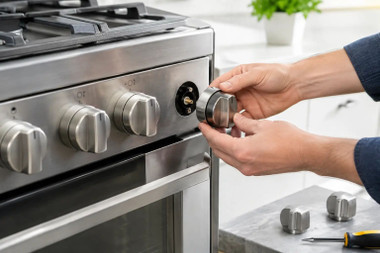
A missing or cracked oven knob can turn a simple dinner into a frustrating guessing game. Knowing how to replace oven knobs starts with more than finding a handle that looks similar: the replacement must fit the control shaft correctly and match the way your range operates. A poorly matched knob may slip, point to the wrong setting, or fail to turn the control at all.
The good news is that most oven knobs are designed for straightforward replacement. With the appliance model number, a quick look at the shaft behind the old knob, and a few careful checks before ordering, many homeowners, landlords, and maintenance teams can complete the job in minutes.
Start With Safety and the Appliance Model Number
Turn every burner and oven control to the OFF position before handling the knobs. If you are cleaning around the controls or removing multiple knobs, it is also sensible to unplug an electric range. For a gas range, do not force a control or attempt to disassemble the valve behind the knob. Replacing the external knob is generally simple; servicing a gas valve or electrical control is a different repair.
Next, locate the appliance model number. It is often found on a label around the oven door frame, behind the storage drawer, on the side of the appliance, or in the owner's paperwork. Write down the complete model number, including letters and numbers. A brand name alone is rarely enough because the same manufacturer may use different knob styles, shaft sizes, and control layouts across its ranges.
If the original knob is still available, keep it nearby. Its shape, underside opening, indicator line, and any part number molded into the plastic can help confirm a compatible replacement.
How to Replace Oven Knobs Step by Step
Most standard range knobs pull straight off the control shaft. Grip the knob firmly near its base and pull directly toward you. Avoid twisting hard while pulling, especially if the shaft feels loose. If grease or baked-on residue has made the knob stick, hold a soft cloth behind it and apply steady, even pressure rather than prying against the appliance panel with a tool.
Once the knob is removed, inspect the shaft. Common styles include a flat-sided D-shaped shaft, a splined shaft with small ridges, and a round shaft with a flat section. The opening on the replacement knob must match that shaft style and size. A knob that is too loose can rotate independently of the control. One that is too tight may crack or put unnecessary pressure on the control assembly.
To install the new knob, align the opening with the shaft and push it on straight. It should seat securely without excessive force. Check that the indicator line points to OFF when the control is off. Then turn the knob slowly through its normal range and confirm it moves smoothly and reaches the expected settings.
For an oven temperature knob, compare the pointer with the temperature markings on the control panel. For a burner knob, verify that OFF, light, low, and high positions align sensibly. If the pointer is noticeably off, remove the knob and recheck the shaft orientation and compatibility before using the appliance.
Choose an Exact-Fit Knob When Possible
An exact replacement knob made for your range model is usually the best choice. It is more likely to fit correctly, sit at the proper depth, and align with the printed control markings. This matters most on gas ranges, where turning to the correct ignition position is necessary for normal operation.
When shopping for an appliance replacement part, compare these details with the original knob and your appliance information:
- Appliance brand and complete model number
- Knob function, such as surface burner, oven temperature, timer, or selector control
- Shaft style and opening shape
- Knob diameter, depth, and stem length
- Indicator line location and color
- Part number, if printed on the original piece or listed in the appliance parts diagram
A set of knobs may look more consistent than replacing one damaged piece, but appearance should not be the only consideration. Some ranges use different knobs for different functions. For example, the oven thermostat knob may have a different internal opening or pointer position than the burner knobs. Check each control before ordering a multi-pack.
Are Universal Oven Knobs a Good Option?
Universal knobs can be useful when the original part is discontinued, when an older rental unit needs an affordable fix, or when you need a short-term replacement for a common shaft style. Many universal models include adapters intended to fit several shaft sizes and shapes.
The trade-off is that universal does not always mean precise. An adapter can make the knob feel secure while leaving the indicator line slightly misaligned. The knob may also sit farther away from the panel than the original, which can affect appearance and how naturally it turns. For a control that has a specific ignition or temperature position, a model-specific replacement is generally the better long-term choice.
Before selecting a universal knob, measure the shaft and read the product details carefully. Confirm whether adapters are included, what shaft styles they support, and whether the package is designed for a range control rather than another appliance. Do not assume a knob for a dryer, grill, or other appliance will work safely on an oven simply because it can slide onto the shaft.
Common Problems After Replacing a Knob
If the new knob spins without moving the control, its opening or adapter is too large, worn, or incompatible with the shaft. Remove it rather than continuing to use it. A spinning knob makes it difficult to know whether the burner or oven is actually off.
If the knob will not push on, verify that you have the correct shaft type and that no broken plastic from the old knob remains on the shaft. Do not hammer or force the new knob into place. Excessive pressure can damage the control stem behind the panel, turning a simple replacement into a larger repair.
If the pointer does not line up with OFF or the temperature markings, first make sure the control shaft itself is in the off position. Some knobs are installed in only one orientation, while others can fit several ways. If correct alignment is impossible, the knob may not be designed for that control.
A knob that is difficult to turn after installation deserves attention. Remove it and test the bare shaft gently. If the shaft itself is stiff, loose, bent, or unusually difficult to turn, the issue may be inside the control assembly rather than the knob. Stop using a gas control that does not operate normally, particularly if you smell gas or the burner does not behave as expected.
Clean the Control Area Before Installing the New Knob
Replacing a knob is a good opportunity to clean the area around the control shaft. Remove loose crumbs and wipe away surface grease with a lightly damp cloth and a mild household cleaner suitable for appliance exteriors. Keep moisture away from openings behind the control panel, and dry the area fully before installing the new part.
Avoid spraying cleaner directly into the shaft opening. Liquid can travel behind the panel and may affect switches or controls. If residue has built up inside the old knob, cleaning may restore its appearance, but it will not repair cracked plastic, a stripped opening, or a loose metal insert. Replace damaged knobs rather than relying on glue or tape.
When a Knob Replacement Is Not Enough
The knob is only the visible part of the control. Call a qualified appliance technician if the shaft is broken, the burner will not shut off, the oven temperature behaves unpredictably, or a gas control will not ignite or turn normally. Those symptoms can point to a failed switch, valve, thermostat, or electronic control component.
For property managers and maintenance teams, keeping the model number and compatible replacement part details on file can reduce downtime when a knob is lost or damaged. Ordering a correctly matched spare is often more practical than trying to identify a part during an urgent turnover or repair visit.
A correctly fitted oven knob gives you clear, dependable control over a frequently used appliance. Take a minute to match the model, shaft, and indicator position before buying, and the replacement should be one of the quickest maintenance fixes in the kitchen.
Recent Posts
-
How to Organize Toys With Clear Storage Bins
Toy clutter tends to peak right before the holidays, when birthday gifts from the year are still sca …Oct 23, 2026 -
Folding Chairs for Church Halls and Community Centers
Church halls, fellowship rooms and community centers ask more of their seating than almost any home. …Oct 23, 2026 -
Restaurant Bus Cart Guide: Using a Utility Cart for Bussing
Every busy dining room hits the same wall at some point in a shift: dirty plates stack up, servers m …Oct 23, 2026