How to Install a Refrigerator Shelf Correctly
A refrigerator shelf that rocks, sags, or will not slide into place is more than an annoyance. It can make food storage harder, create a spill risk, and put extra stress on shelf supports. If you are searching for how to install refrigerator shelf replacements, the key is not forcing the shelf into position. Start by confirming that the shelf, rails, and supports match your refrigerator’s interior design.
Most refrigerator shelves install without special tools. However, a glass shelf with a plastic frame, a wire shelf, and a crisper-cover shelf each lock into place differently. Taking a minute to identify the mounting style can prevent a cracked shelf frame or broken support tab.
Before You Install a Refrigerator Shelf
Remove food, containers, and loose drawers from the area around the shelf opening. This gives you room to work and keeps a heavy item from falling while you are adjusting the shelf. If the shelf sits above crispers, pull those drawers out first so you can clearly see the side rails and rear supports.
Check the replacement shelf before installing it. Compare its overall width and depth with the original shelf if you still have it. Look at the back edge, front trim, side notches, and any tabs underneath. A shelf may look nearly identical to another model but use different clips or sit at a different height.
Also inspect the refrigerator interior. The shelf supports may be built into molded side rails, attached as individual plastic pegs, or formed as metal tracks. Make sure no support is cracked, bent, loose, or missing. Replacing a shelf will not solve the problem if the shelf support itself is damaged.
For a glass shelf, inspect the glass and surrounding frame before use. Do not install a shelf with chipped glass, a separated frame, or a deep crack. Even if it seems stable at first, it may fail under the weight of groceries.
Confirm the Correct Shelf Position
Many refrigerators have several shelf-height options. The shelf needs to rest on matching support levels on both sides. If one side is set higher than the other, the shelf can tilt and may not engage at the back.
Consider what you plan to store before choosing the height. A lower position can make room for tall pitchers or beverage bottles, while a higher position may create more usable space for deli containers or leftovers. Keep enough clearance above the shelf to remove containers without scraping the refrigerator ceiling or door bins.
How to Install a Refrigerator Shelf Step by Step
The exact motion depends on your refrigerator model, but the process below works for many standard adjustable shelves.
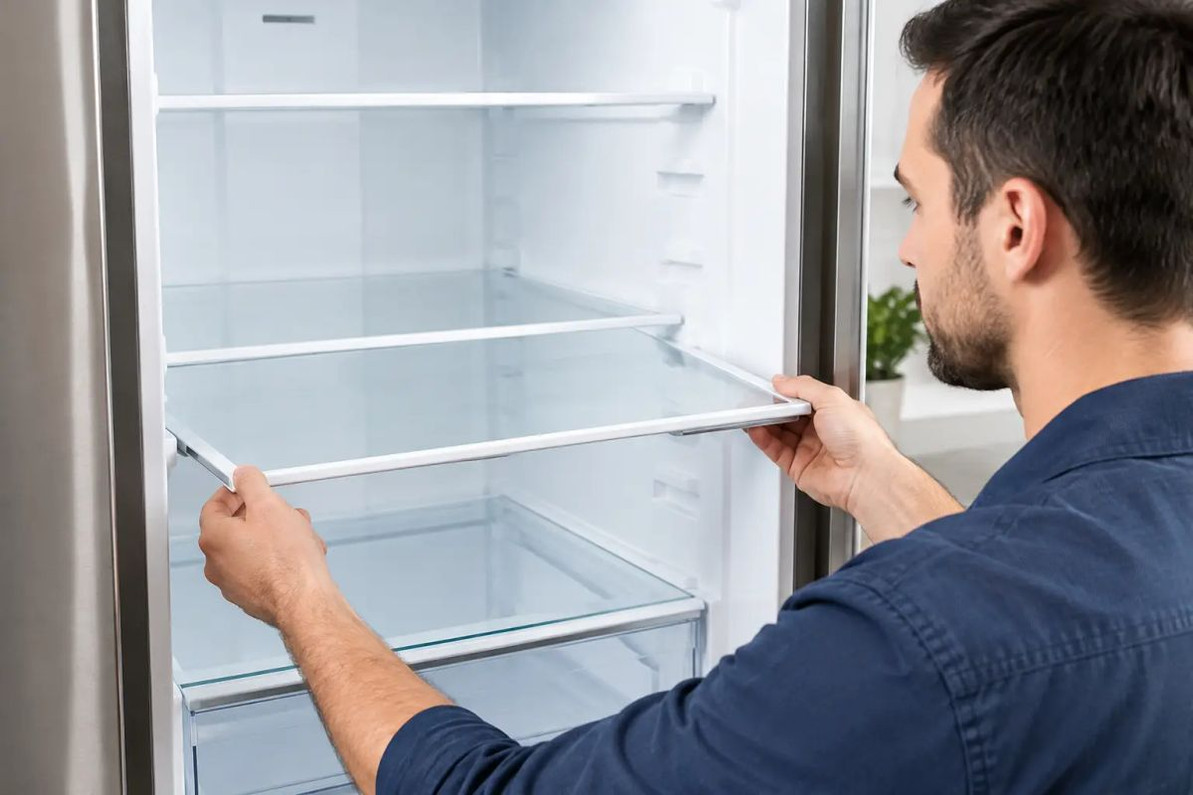
First, hold the shelf with both hands and keep it level. For shelves with a raised rear lip or tabs, position the back edge toward the rear wall of the refrigerator. If the shelf has a trim piece or rounded edge, that usually faces forward.
Next, place the rear corners or tabs onto the appropriate side rails or support ledges. On many glass shelves, the rear edge must sit slightly above the supports before it can slide backward into its locking position. Do not push hard. If the shelf stops immediately, pull it back out and check whether the tabs are aligned with the rail openings.
Once the rear edge is seated, lower the front of the shelf slowly until it rests evenly on the front supports. Some models require a gentle downward press at both front corners to engage locking tabs. Others simply sit on support pegs. You should not need to bend the shelf, twist the frame, or strike it with your hand.
After installation, pull the shelf forward very lightly. A shelf designed to lock into rails should not lift or slide out easily. Then press down near each front corner and look across the shelf from the side. It should sit level without rocking.
Finally, return drawers and food to the refrigerator. Start with lighter items and distribute heavier containers across the shelf rather than concentrating them in one area. Avoid placing large pots, dense beverage packs, or oversized containers on a shelf unless your refrigerator documentation indicates it is suitable for that load.
Installing Common Refrigerator Shelf Types
Glass Shelves With Plastic Frames
These are common in modern top-freezer, bottom-freezer, and side-by-side refrigerators. The glass is often held in a plastic frame that includes rear hooks, side tabs, or molded runners. Install the framed shelf by engaging the rear features first, then lowering the front.
Do not hold this type of shelf by only the glass panel. Support the frame from underneath with both hands. The frame carries the connection points, while the glass can be vulnerable to edge impacts.
Wire Shelves
Wire shelves are usually lighter and may simply rest on metal rails or plastic support pegs. Align the shelf so the raised edge, if present, faces the correct direction. Lower it onto all supports and make sure the wire grid is not resting on only one side.
If a wire shelf wobbles, check for a bent corner or a missing support peg. Do not try to compensate by placing cardboard, tape, or loose shims under the shelf. That can make the shelf less stable and interfere with cleaning.
Crisper-Cover Shelves
The shelf above produce drawers often includes a glass panel, plastic frame, and rails that guide the crispers. This assembly can be more involved because it may sit behind or under fixed tabs at the rear.
Remove both crisper drawers first. Set the cover into the rear slots or supports, lower it evenly, and check that the drawer rails are aligned before reinstalling the drawers. If a crisper catches or will not close, the cover may be sitting backward or one side may not be fully seated.
Problems That Can Prevent Proper Installation
A replacement shelf that will not fit is often a compatibility issue, not an installation mistake. Refrigerator shelf dimensions alone are not enough. Two shelves with the same width can have different rear hooks, frame thicknesses, or rail locations.
Use the refrigerator model number when selecting a replacement. It is commonly found on a label inside the fresh-food compartment, along an interior wall, behind a crisper drawer, or near the door frame. Match the part description and shelf type to that model number whenever possible. This is especially useful for landlords, maintenance teams, and property managers who need to order the right part before arriving for a repair.
A shelf can also fail to seat because of food debris or ice around the rails. Wipe the support areas with a soft cloth and warm water, then dry them thoroughly. Avoid using sharp tools to remove buildup near plastic tabs, since a small crack can keep the shelf from staying in place.
If a shelf slides forward unexpectedly, look for broken locking tabs on the shelf frame or worn rail stops inside the refrigerator. If the shelf rocks from side to side, confirm that all support pegs are installed at the same level and fully inserted. Replacing only the shelf may not correct a damaged support system.
When to Replace the Shelf Supports Too
Shelf supports are inexpensive parts compared with the inconvenience of a failed shelf. Replace them when they are visibly cracked, discolored from stress, loose in the liner, or unable to hold the shelf level. A good replacement shelf needs solid contact points at every corner.
If the refrigerator’s molded interior rail is cracked, the repair may require a model-specific solution rather than a new shelf alone. Avoid loading the area until you have identified the damaged component. Continuing to use a shelf on compromised supports can damage the replacement part and spill stored items.
For routine maintenance, remove the shelf occasionally and clean the rails, trim, and support points. This keeps crumbs and sticky spills from interfering with installation. It also gives you an early chance to spot worn tabs before they break under load.
A correctly installed refrigerator shelf should feel ordinary once it is in place: level, steady, and easy to use. Verify compatibility, support it with both hands during installation, and never force a part that does not line up. Those few checks make it much easier to keep your refrigerator organized and ready for everyday use.
Recent Posts
-
How to Organize Toys With Clear Storage Bins
Toy clutter tends to peak right before the holidays, when birthday gifts from the year are still sca …Oct 23, 2026 -
Folding Chairs for Church Halls and Community Centers
Church halls, fellowship rooms and community centers ask more of their seating than almost any home. …Oct 23, 2026 -
Restaurant Bus Cart Guide: Using a Utility Cart for Bussing
Every busy dining room hits the same wall at some point in a shift: dirty plates stack up, servers m …Oct 23, 2026