How to Choose Warehouse Platform Carts for Work
A cart that is too small creates extra trips. A cart that is too large can be hard to turn in narrow aisles, difficult to store, and more expensive than the job requires. The right warehouse platform carts help a stockroom, shipping area, maintenance department, or small business move more goods with less lifting and less wasted time.
For many operations, a platform cart is one of the simplest equipment upgrades available. It can handle cartons, storage bins, office supplies, maintenance materials, retail inventory, and bulky items that are awkward to carry by hand. Choosing one comes down to the load, the route, the floor, and the people using it every day.
Start With the Load, Not the Cart
Capacity is the first specification to check, but the highest capacity is not always the best choice. Start by identifying the heaviest load the cart will carry under normal conditions, then leave a reasonable safety margin. A cart moving a few shipping boxes may only need a moderate rating. A cart used for dense cases of inventory, tools, hardware, or equipment parts may need substantially more capacity.
Weight alone does not tell the whole story. Consider the shape and footprint of the load. Long cartons, stacked totes, and loose materials can become unstable even when they are well below the listed weight limit. A wide, flat load is usually easier to control than a tall stack with a high center of gravity.
Avoid routinely loading a cart to its maximum rating. The listed capacity generally assumes weight is distributed evenly across the deck. Concentrated loads, sudden stops, uneven thresholds, and rough floors place extra stress on the platform, wheels, and frame. Selecting a cart with room to spare helps extend its service life and makes daily handling safer.
Match the Platform Size to Your Workflow
Deck length and width determine how much product can move in one trip. A compact platform is a practical choice for mailrooms, retail backrooms, apartment maintenance teams, and tight storage areas. It takes less space to park and is easier to guide around shelving.
A larger deck works well for receiving areas, warehouse aisles, bulk storage, and shipping stations where employees regularly move multiple cartons or oversized items. The trade-off is maneuverability. Before purchasing, measure narrow aisles, doorways, elevator openings, turns around racks, and the available parking area.
Think about the materials being moved as well. Cartons should sit fully on the platform whenever possible. Overhanging boxes are more likely to catch on door frames or shelving and can make steering unpredictable. If you typically carry several small items, a raised edge, removable sides, or a second shelf may provide better control than an open flat deck.
Flat Decks, Raised Edges, and Multi-Shelf Designs
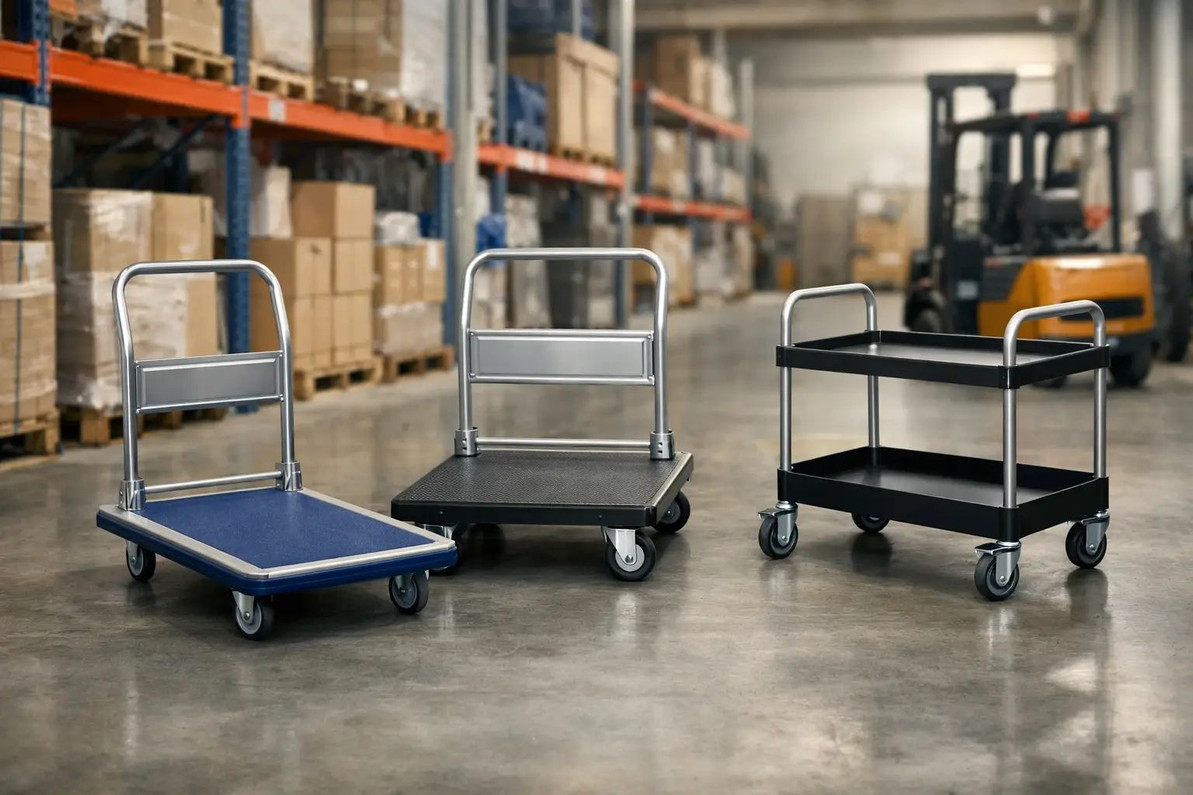
A flat platform cart is the most flexible option. It is useful for large boxes, storage containers, furniture, and equipment because loads can be placed directly on the deck from almost any angle. It also makes loading with a forklift or pallet jack easier when the cart design and work area allow it.
Raised-edge platforms help keep bins, packages, and loose supplies from shifting. They are a good fit for maintenance carts, order-picking tasks, and routes with door thresholds or uneven concrete.
Multi-shelf carts can improve organization when workers need to separate orders, tools, or supplies. They are not the best choice for every load, though. Shelf spacing limits the height of what can be carried, and tall carts require careful loading to prevent tipping. Choose the design that reduces handling steps for the items you move most often.
Wheel Type Makes a Major Difference
The wheels determine how a cart feels in actual use. A high-capacity deck with poor casters can still be frustrating, noisy, and hard to steer. Consider the floor surface, how often the cart will be used, and whether it crosses thresholds, ramps, or outdoor areas.
Hard wheels generally roll easily on smooth, level warehouse floors and can be a cost-effective option for indoor use. Softer rubber or polyurethane wheels often offer a quieter ride, better shock absorption, and more grip. They can be especially helpful on imperfect concrete, tile, or mixed surfaces where vibration may shift the load.
Larger-diameter wheels usually roll over cracks, cords, thresholds, and small debris more easily than smaller wheels. They can make a noticeable difference in older facilities or loading areas. However, larger wheels may raise the deck height, which can affect loading convenience.
Caster configuration matters, too. Two fixed wheels paired with two swivel casters provide stable straight-line travel and controlled turns. Four swivel casters offer tighter maneuvering in confined spaces, but heavily loaded carts can require more attention to keep moving straight. For carts used on ramps or parked during loading, wheel brakes are a worthwhile safety feature.
Select a Handle That Fits the Route
A push handle seems like a minor detail until someone uses the cart for an entire shift. A sturdy handle gives workers better leverage, helps maintain control, and keeps hands away from the load. For most applications, pushing is safer and easier to control than pulling, especially when moving heavier materials.
Fixed handles are simple and dependable. Folding handles are useful where storage space is limited or carts must be transported in a service vehicle. A fold-down handle also allows the platform to serve as a lower-profile moving surface for bulky items.
Check handle placement against the expected load. If tall boxes block the operator's view, employees may need to position the load differently, use a second person, or select a cart with a design that improves visibility. Safe operation depends on more than a capacity label.
Consider Frame and Deck Materials
Steel platform carts are a common choice for demanding warehouse, maintenance, and commercial use. They provide dependable support for heavier materials and repeated use. A powder-coated finish can help resist scratches and corrosion in dry indoor environments, though no finish eliminates the need for basic care.
Aluminum carts weigh less and may be easier to handle when the cart itself needs to be lifted, stored, or loaded into a vehicle. They are often a practical option for mobile service teams. Their ideal capacity range depends on the frame design, so compare specifications instead of assuming that a lighter cart is suitable for every heavy-duty job.
Plastic or composite decks can be easy to clean and resistant to moisture. They work well in supply rooms, food-adjacent areas, offices, and light commercial settings. For sharp-edged equipment, very dense materials, or high-impact loading, a steel deck may be the better long-term choice.
Build Safety Into Everyday Use
A platform cart reduces lifting, but it does not remove the need for safe material-handling practices. Train employees to place heavier items low and centered on the deck. Keep loads stable, avoid blocking sight lines, and never stack materials so high that they can fall during a turn.
Use straps, shrink wrap, or other appropriate restraints when transporting uneven, tall, or loose loads. Slow down near ramps, dock edges, pedestrians, and blind corners. If a cart is difficult to control, the answer may be a lower load, better wheels, a different route, or a cart better suited to the task.
A quick pre-use check can prevent downtime and injuries. Look for loose fasteners, bent handles, damaged deck surfaces, flat spots on wheels, and casters that do not swivel freely. Remove a damaged cart from service until it is repaired or replaced. Trying to get one more day out of failing equipment usually costs more when it delays work or damages inventory.
When One Cart Is Not Enough
Some businesses try to make a single cart cover every job. That can lead to overloading, inefficient trips, and equipment that is always in the wrong place. If receiving, order picking, maintenance, and office supply delivery happen at the same time, a small fleet of carts with different sizes or features may be more cost-effective.
For example, a compact folding cart can serve a maintenance team, while a larger steel platform cart stays near receiving or shipping. Dedicated carts reduce the time workers spend searching for equipment and help keep processes moving during busy periods. Commercial buyers can also benefit from volume pricing when outfitting multiple departments or locations.
Easy Deal USA offers practical equipment options for workplaces that need dependable value, whether you are improving a busy warehouse route or making a small stockroom easier to manage.
Before placing an order, measure the route, confirm the heaviest typical load, and choose wheels and a deck style that match the work rather than just the product photo. A well-chosen cart earns its space every time it turns a difficult carry into one controlled trip.
Recent Posts
-
How to Organize Toys With Clear Storage Bins
Toy clutter tends to peak right before the holidays, when birthday gifts from the year are still sca …Oct 23, 2026 -
Folding Chairs for Church Halls and Community Centers
Church halls, fellowship rooms and community centers ask more of their seating than almost any home. …Oct 23, 2026 -
Restaurant Bus Cart Guide: Using a Utility Cart for Bussing
Every busy dining room hits the same wall at some point in a shift: dirty plates stack up, servers m …Oct 23, 2026