How to Choose a Platform Cart for Your Workload
A platform cart can make a long shift easier or create a daily frustration if it is too small, hard to steer, or not built for the loads you actually move. Knowing how to choose a platform cart starts with looking beyond the listed weight capacity. The right cart needs to fit your load size, floor surface, route, storage space, and the person using it.
How to Choose a Platform Cart for the Job
Start with the work, not the cart. A homeowner moving storage bins from a garage to an attic landing needs something very different from a stockroom employee transporting cases of supplies across a concrete floor. Think through what goes on the deck, how far it travels, and what obstacles are in the way.
Write down the heaviest typical load, rather than planning around the occasional light box. If you regularly move several cartons, toolboxes, or bulk supplies at once, estimate their combined weight. Leave a reasonable margin instead of choosing a cart rated exactly at your expected load. That extra capacity helps account for uneven loading, repeated use, and the reality that boxes are not always packed perfectly.
Also consider whether the load is compact or oversized. A cart may have enough capacity for a heavy appliance part or stack of packages but still be a poor match if the deck is too short or narrow. Loads that hang far over the deck can shift, catch door frames, or make turns harder to control.
Match the Weight Capacity to Real Use
Capacity is often the first specification shoppers compare, and it matters. However, it should not be the only deciding factor. A higher-capacity platform cart usually makes sense for warehouse supplies, maintenance equipment, bulk deliveries, and frequent commercial use. For occasional household tasks, a lighter cart with a practical capacity may be easier to store and handle.
Check whether the stated rating applies to an evenly distributed load. Most carts perform best when weight is centered on the platform, not piled at one edge or concentrated over a single wheel. Tall or uneven stacks can become unstable even when they are below the cart's rated capacity.
It also helps to think about frequency. Moving 150 pounds once a month is different from moving it repeatedly throughout the day. For regular business use, prioritize a durable frame, dependable wheel hardware, and a deck that will hold up to repeated loading. A cart intended for occasional use may be a good value for a garage, rental property, classroom, or home office, but it may not be the best choice for daily receiving or fulfillment work.
Choose a Deck Size That Supports Your Load
The platform is where the cart earns its place. Measure common boxes, totes, equipment, or supplies before buying. For example, an e-commerce seller may need a deck wide enough for shipping cartons and packing materials, while a property manager may need space for cleaning supplies, replacement parts, or maintenance tools.
A larger deck lets you move more in one trip, but it also makes the cart harder to fit through tight aisles, elevators, narrow doorways, and crowded storage rooms. Measure your narrowest regular passage, especially if you work in an older building, apartment complex, or small back room.
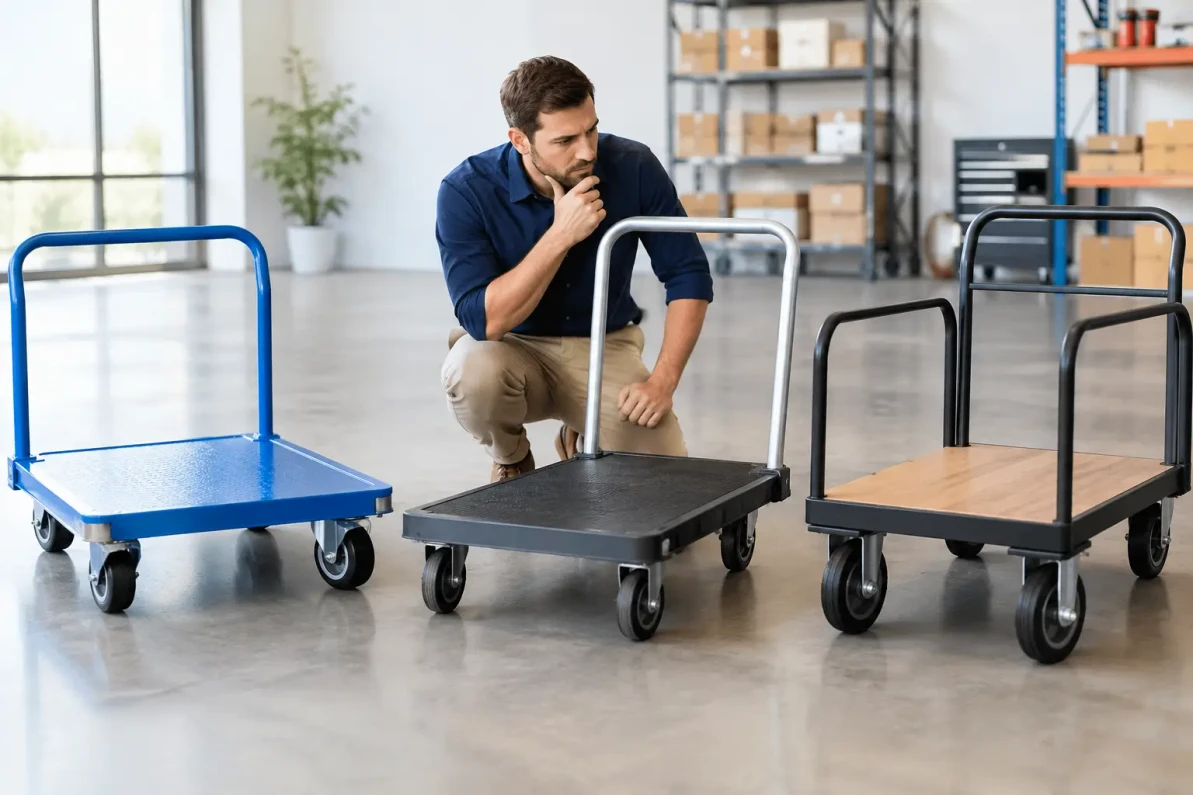
Deck material affects day-to-day usability as well. A textured or non-slip surface can help keep boxes and plastic bins from sliding. A smooth deck may be easier to wipe down after dusty workshop or warehouse jobs. Raised edges can offer some support for loose items, while a flat open deck is often more convenient for oversized cartons.
Select Wheels for Your Floor Surface
Wheel choice has a major effect on how a loaded cart feels. Small, hard wheels may work well on smooth indoor flooring but can be difficult over cracks, thresholds, rough concrete, or uneven pavement. Larger wheels generally roll over minor obstacles more easily and can reduce the effort needed to pull a load.
For indoor use on smooth concrete, tile, or sealed floors, non-marking wheels can be a practical choice where scuff marks are a concern. For garages, loading areas, workshops, and uneven surfaces, choose wheels designed to handle rougher travel conditions. The best option depends on where the cart spends most of its time, not just where it is stored.
Pay attention to the caster layout. Swivel casters make a cart easier to turn in tight spaces. Fixed wheels help it track in a straight line. Many platform carts combine both, giving you a balance of steering control and stability. If you routinely navigate tight shelves or crowded work areas, maneuverability may matter more than maximum deck size.
Brakes are worth considering when you load or unload on a slight incline, work around ramps, or need to keep the cart in place while sorting materials. They do not replace careful loading practices, but they add useful control in the right setting.
Decide Between a Folding or Fixed Handle
A folding-handle platform cart is a practical space-saving option for homes, apartments, service vehicles, small offices, and businesses with limited storage. When folded, it can often fit against a wall, under a workbench, or in a utility closet. It is also easier to transport in a vehicle when needed.
A fixed-handle cart may be a better fit for dedicated work areas where the cart is always in use. With fewer moving parts at the handle, it can feel more straightforward for repeated loading and transport. The trade-off is storage space. Make sure a fixed handle will not block an aisle or create an obstacle when the cart is parked.
Handle height matters, too. A comfortable handle helps users push or pull with better control. If several people will use the cart, choose a design that feels manageable for the most common users and does not require awkward bending or reaching.
Consider Your Route, Not Just the Destination
A cart that works well on an open warehouse floor may be frustrating in a narrow hallway. Before choosing, walk the route your load takes from start to finish. Look for door thresholds, ramps, elevator gaps, floor transitions, tight turns, crowded aisles, and outdoor areas exposed to dirt or debris.
If the cart must travel between indoor and outdoor spaces, wheel performance becomes especially important. If it will be used near customer areas, building lobbies, or finished flooring, choose a size and wheel style that is easier to control and less likely to interfere with foot traffic.
For taller loads, check your line of sight. Stacking boxes so high that you cannot see ahead creates unnecessary risk. In some cases, a wider platform that allows a lower, more stable load is more useful than a cart with a very high capacity rating.
Look for Features That Save Time
The best extra features are the ones that solve a real daily problem. A non-slip deck can help with smooth plastic totes. Edge bumpers can help protect walls and furniture in tight spaces. A folding handle can simplify storage. Brakes can make loading more controlled. These features are useful when they match your environment, but they should not distract from the basics: appropriate capacity, usable deck space, and wheels suited to the floor.
For businesses ordering several carts, consider consistency. Using the same general cart style across a stockroom, maintenance team, or shipping area can simplify storage, training, and replacement planning. For a mixed workload, it may be smarter to use one larger cart for bulk items and a compact folding cart for quick tasks rather than expecting one model to do everything.
A Quick Pre-Purchase Check
Before placing an order, confirm these practical details:
- The cart's capacity exceeds your usual loaded weight with room to spare.
- The deck fits your common boxes, bins, or equipment without excessive overhang.
- The wheels match the surfaces, thresholds, and turns on your normal route.
- The handle style fits your available storage space and frequency of use.
- The cart dimensions can pass through your narrowest doorway or aisle.
A platform cart should reduce trips, strain, and clutter, not become another item that is difficult to store or steer. Choose the model that fits the work you do most often, load it evenly, and keep its travel route clear. That practical match will serve you better than simply buying the biggest cart available.
Recent Posts
-
Frigidaire Fridge Door Shelf Rail Broken: Replace 240534901
If the door shelf rail on your Frigidaire refrigerator has cracked, snapped off or keeps popping loo …Nov 21, 2026 -

Storage Totes for Contractors: Truck and Jobsite Guide
Every contractor knows the cost of a disorganized truck. You drive to the job, then spend twenty min …Nov 21, 2026 -
How to Pack a Heavy Box for Shipping Without Blowouts
A heavy box fails in predictable ways. The bottom seam splits when someone lifts it, a corner crushe …Nov 21, 2026