How Many Foam Floor Tiles Do You Need for a Home Gym
Setting up a home gym for the colder months usually starts with the floor. Foam floor tiles protect hardwood, tile and concrete, soften the floor for stretching and floor work, and cut down on noise. The question most people get stuck on is simple: how many foam floor tiles do you need for a home gym? Buy too few and you end up with a mat that is too small to move on. Buy too many and you have a stack of leftover pieces in the closet.
This guide walks you through measuring your space, doing the tile math, and picking the right pack size, using our interlocking EVA foam exercise mats as examples.
Step 1: Decide Which Activities the Floor Must Cover
Before you measure the room, decide what you will do on the mat. That tells you how big the covered area needs to be.
- Yoga, stretching and mobility: you need room to lie down fully with your arms overhead and to reach out to the sides.
- Bodyweight and cardio workouts: jumping, lunges and burpees need extra space front to back so you do not step off the edge.
- Exercise equipment: a bike, rower or bench needs its footprint covered plus a margin around it so you can get on and off safely.
- Kids play area: cover the whole zone where kids will sit, crawl and play, not just the center.
A good rule is to add at least a foot of margin on every side of the space you think you need. Mats that are slightly too big can always be trimmed or reconfigured; mats that are too small are frustrating to use.
Step 2: Measure the Area and Calculate Square Feet
Measure the length and width of the area you want to cover in feet, then multiply them. That is your square footage.
- 6 ft x 8 ft = 48 square feet
- 8 ft x 10 ft = 80 square feet
- 10 ft x 10 ft = 100 square feet
- 10 ft x 12 ft = 120 square feet
If the room has an odd shape, split it into rectangles, calculate each one, and add them together. Measure around fixed objects such as radiators, floor vents and door swings so you know where tiles will stop.
Step 3: Do the Foam Floor Tile Math
Divide your square footage by the coverage of one tile. Our 24 piece pack is listed at 96 square feet and the 12 piece pack at 48 square feet, which works out to about 4 square feet of coverage per tile.
Examples using 4 square feet per tile:
- 48 sq ft area: 48 / 4 = 12 tiles. The 12 piece pack covers it.
- 80 sq ft area: 80 / 4 = 20 tiles. The 24 piece pack covers it with a few spares.
- 100 sq ft area: 100 / 4 = 25 tiles. Choose a 24 piece pack plus a 12 piece pack, or a larger pack.
- 120 sq ft area: 120 / 4 = 30 tiles. Two 24 piece packs, or a 24 piece pack plus a 12 piece pack.
Always round up, and plan on a few extra tiles. Interlocking edges, trimming around walls and replacing a worn tile later all use up pieces. Check each product page for the exact tile dimensions before you plan a layout row by row.

Which Foam Floor Tile Pack Size Fits Your Space
12 piece pack: workout corner or yoga zone
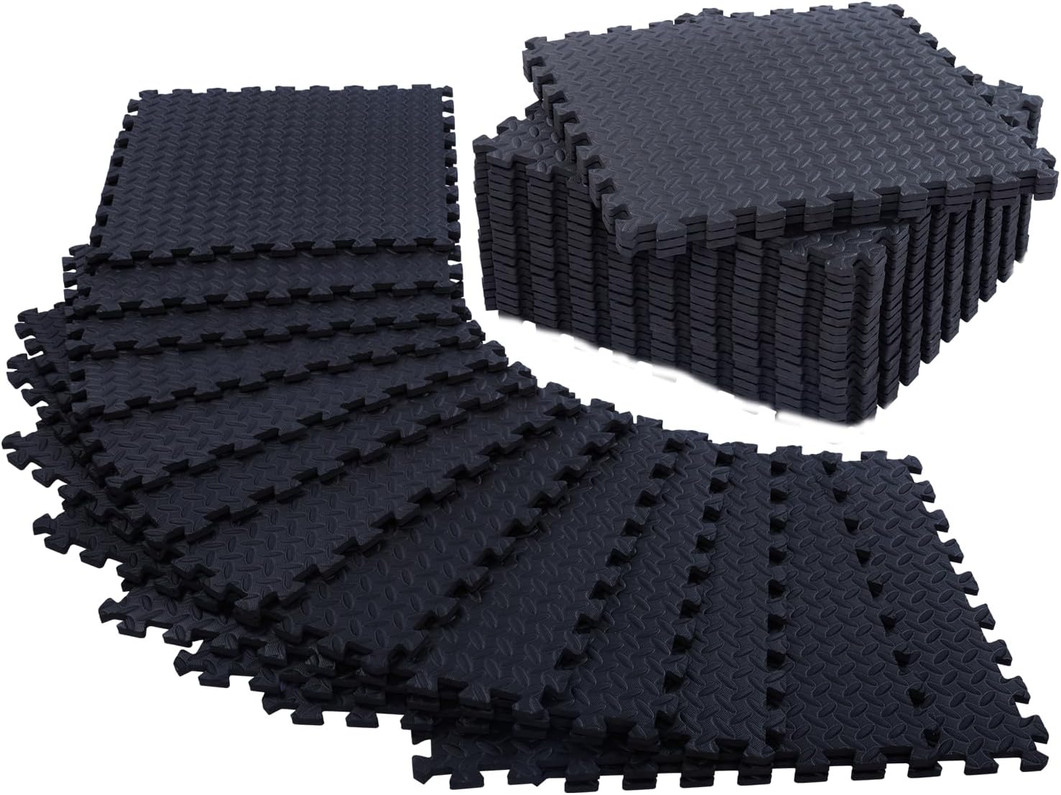
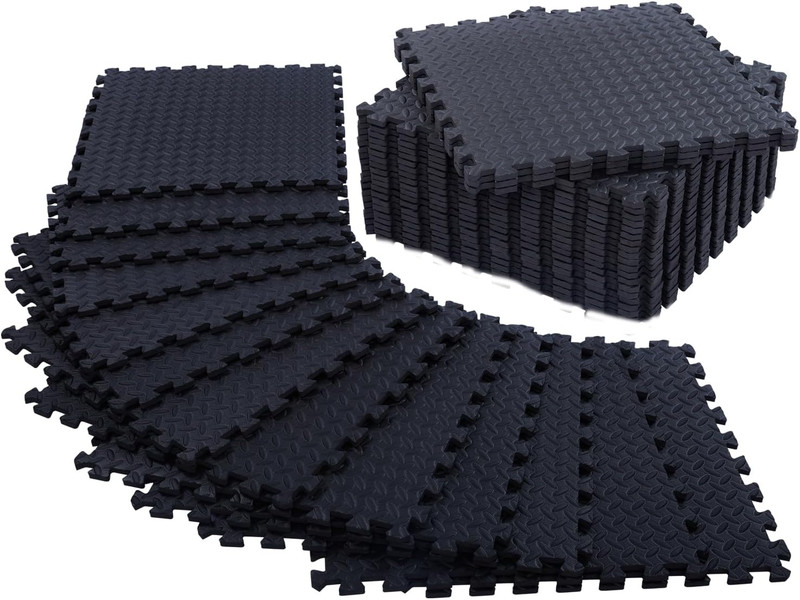
The 12 piece EVA foam mat covers about 48 square feet, which suits a bedroom workout corner, a yoga and stretching space, or the area under a single piece of cardio equipment.
24 piece pack: spare room or garage gym
The 24 piece EVA foam mat covers about 96 square feet, enough for a full workout area in a spare room, basement or one garage bay, or a roomy kids play space.
48 piece pack: larger rooms and combined spaces
For a bigger basement gym or a room that combines a workout area and a play area, the 48 piece EVA foam mat gives you twice as many tiles as the 24 piece pack. Check the product page for the coverage of the option you choose.
All three packs come in black or grey. Black hides scuffs well in a garage or basement; grey reads lighter in living spaces and kids rooms.

How to Install Interlocking Foam Tiles
- Clean and dry the floor. Sweep or vacuum so grit does not get trapped under the tiles.
- Start in a corner or along the straightest wall and work outward.
- Press each joint together along its full length so the puzzle edges lock flat.
- Stagger the layout if your tiles allow it, which helps the mat stay together under movement.
- Trim the last row with a sharp utility knife and a straightedge for a snug fit against walls.
- Place equipment last, setting it down gently rather than sliding it across the joints.
Care and Safety Tips
- Wipe the surface with a damp cloth and mild soap. The 48 piece mat is described as water resistant and easy to clean.
- Check the joints every few weeks and press back any edges that lift, so they do not become a trip hazard.
- Foam tiles cushion floor work and protect the floor, but avoid dropping heavy weights from height onto them. Set dumbbells and plates down under control.
- Keep the tiles out of long, direct sunlight and away from heaters, which can affect foam over time.
- Rotate tiles from high-traffic spots to the edges occasionally to even out wear.
Frequently Asked Questions
How many foam tiles do I need for a 10 x 10 room?
A 10 x 10 room is 100 square feet. At about 4 square feet per tile, you need 25 tiles, so a 24 piece pack plus a 12 piece pack covers the room with spares for trimming.
Can I use foam floor tiles over carpet?
You can lay them over low-pile carpet for light workouts, but they may shift more than on a hard floor. A hard, flat surface gives the most stable result.
Are EVA foam tiles good for a kids play area?
Yes. Our 12 and 24 piece mats list kids play areas among their uses and are described as free of harmful chemicals and toxins. Always supervise young children and keep small trimmed pieces out of reach.
Can I take the mat apart and move it?
Yes. Interlocking tiles pull apart for storage or moving and can be rearranged into a different shape when you change rooms.
Build Your Home Gym Floor
Measure the space, divide by tile coverage, round up and add a few spares. Shop the 12 piece, 24 piece and 48 piece EVA foam exercise mats, or browse more in our Home and Garden category.
Recent Posts
-
How to Organize Toys With Clear Storage Bins
Toy clutter tends to peak right before the holidays, when birthday gifts from the year are still sca …Oct 23, 2026 -
Folding Chairs for Church Halls and Community Centers
Church halls, fellowship rooms and community centers ask more of their seating than almost any home. …Oct 23, 2026 -
Restaurant Bus Cart Guide: Using a Utility Cart for Bussing
Every busy dining room hits the same wall at some point in a shift: dirty plates stack up, servers m …Oct 23, 2026