Hand Truck Reviews: What to Check Before You Buy
A hand truck can turn a stack of boxes, a water heater carton, or a delivery load into one manageable trip. But hand truck reviews are only useful when they compare the details that affect your actual work: load capacity, wheel type, frame size, stair-climbing needs, and where the dolly will be stored between jobs.
The best choice is rarely the one with the highest stated capacity. A heavy-duty steel hand truck may be right for a stockroom or moving crew, while a compact folding model makes more sense for an apartment, service van, or occasional home project. Start with the items you move most often, then choose a design that makes those jobs easier and safer.
How to Read Hand Truck Reviews
A product review that only says a hand truck is "strong" or "easy to use" does not tell you much. Look for specific comments about the load being moved, the surface under the wheels, and how the truck performs at curbs, thresholds, ramps, or stairs. A dolly that rolls well across a smooth warehouse floor may be frustrating on cracked pavement or gravel.
Pay close attention to the difference between listed capacity and useful capacity. Capacity is the maximum weight the frame is designed to carry under proper conditions. Useful capacity is what you can control comfortably with your typical load. A tall, narrow stack of cartons can become difficult to balance long before it reaches the capacity rating.
Also consider the reviewer’s use case. A homeowner moving a few storage bins has different needs than a property manager relocating appliances or an e-commerce seller moving incoming inventory. Reviews are most helpful when the job described looks like yours.
Check the Frame and Toe Plate
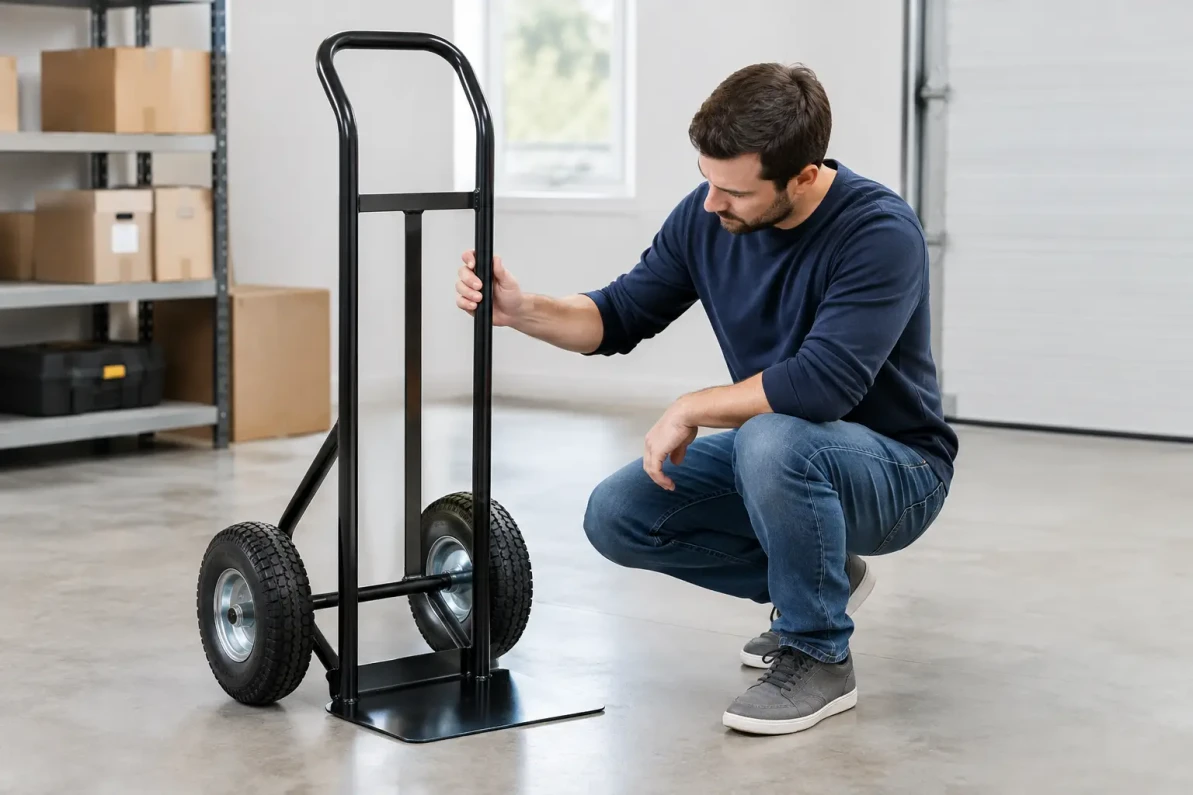
The frame carries the load, but the toe plate starts the lift. A deeper toe plate gives more support under wider boxes, appliances, and bulky containers. It can also make loading easier when cartons are slightly damaged or not perfectly square. The trade-off is that a larger toe plate can add bulk and reduce convenience in tight storage areas.
Steel frames are a practical choice for frequent heavy use because they are generally better suited to rough handling and repeated loading. Aluminum frames are often lighter to carry and easier to lift into a vehicle. Neither option is automatically better. If you regularly move dense, heavy materials, frame strength and stability usually matter more than saving a few pounds. If you carry the hand truck up steps or load it into a van several times a day, a lighter design can reduce hassle.
Look at the overall frame height, too. Taller frames give better leverage on tall cartons and stacked loads. Shorter models can be easier to store and may be more convenient for smaller boxes. For mixed work, a medium-height frame with a properly sized toe plate is often the most versatile option.
Wheel Types Matter More Than Many Buyers Expect
Wheels have a major effect on control, comfort, and where a hand truck can be used. In hand truck reviews, this is often where the most practical differences show up.
Solid rubber or hard wheels are low-maintenance and work well on smooth indoor floors. They do not need air, so there is no concern about a flat tire while moving inventory or supplies. Their downside is a firmer ride over uneven pavement, expansion joints, and rough loading areas.
Pneumatic wheels use air-filled tires and provide more cushioning over outdoor surfaces. They are a sensible option for moving garden materials, equipment, or boxes across driveways and uneven ground. However, they require occasional pressure checks and can go flat. Semi-pneumatic wheels offer a middle ground, giving some shock absorption without the same level of tire maintenance.
Wheel diameter also affects performance. Larger wheels generally roll more easily over thresholds, curb edges, and uneven surfaces. Smaller wheels can be fine for smooth floors and lighter loads, especially on compact folding hand trucks. If your route includes a loading dock, parking lot, or rough concrete, wheel size deserves as much attention as the frame rating.
Folding Hand Trucks vs. Traditional Upright Dollies
A folding hand truck is built around convenience. It typically has a telescoping handle, a fold-out toe plate, and a compact profile for storage in a closet, trunk, or service vehicle. This style is useful for office supplies, packages, small moving jobs, and deliveries where space is limited.
The compromise is that folding models usually have a smaller toe plate and a lighter overall structure than traditional upright dollies. They can be excellent for their intended purpose, but they are not always the right tool for repeated appliance moves, large furniture cartons, or heavy warehouse loads.
A traditional upright hand truck takes up more storage space but usually offers a larger frame, bigger wheels, and better leverage. For maintenance teams, small businesses, landlords, and warehouse operators, that added stability can be worth it. If your hand truck will see frequent use, a full-size model often saves time and reduces the need to make extra trips.
Convertible hand trucks add another option. These designs can operate upright like a standard dolly or lay down as a four-wheel cart. They are useful for wider loads that do not stack well vertically, such as long boxes, multiple cartons, or equipment cases. Because a convertible model has more moving parts, check how easily it shifts between positions and whether it feels stable in both configurations.
Match the Capacity to the Load and the Route
Before buying, weigh or estimate the heaviest item you expect to move, then add a practical margin. Do not select a hand truck that barely meets the expected load. Cartons can contain more than their label suggests, and a load may include straps, packing materials, or stacked items.
Just as important, think about the route. Moving a 200-pound load across a level concrete floor is very different from pulling it over a doorstep or up a ramp. Slopes, uneven surfaces, narrow hallways, and stairs all reduce how much weight is comfortable to handle. For stair work, focus on control and wheel design rather than trying to maximize capacity alone.
Load shape matters as well. A compact box of tools may be heavy but easy to control because its weight stays close to the frame. A lighter but tall stack of boxes can be awkward if the weight sits high or shifts during movement. Keep loads centered over the axle, secure loose items with straps when needed, and avoid stacking so high that you cannot see where you are going.
Details That Improve Everyday Use
A few small design details can make a noticeable difference during regular use. Grip style affects comfort and control, especially when hands are dusty, gloved, or damp. A handle with enough clearance is easier to use without scraping knuckles against the frame or load.
Frame finish is worth checking for equipment used in garages, stockrooms, or outdoor loading areas. Scratches are normal, but a durable finish helps the hand truck stay presentable and easier to maintain. Weld quality, axle fit, and wheel hardware also deserve a quick inspection when the product arrives. Tighten hardware as needed before putting the dolly into regular service.
Storage is another practical factor. Measure the space behind a door, inside a utility closet, or in your vehicle before choosing a full-size hand truck. A larger model is of little value if it blocks a walkway or never makes it into the vehicle when you need it. Folding designs earn their place when storage limits are real, not simply because they look convenient online.
A Practical Buying Checklist
Before adding a hand truck to your cart, confirm these four basics:
- The capacity comfortably exceeds your heaviest normal load.
- The toe plate supports the box, appliance, or material size you move.
- The wheels suit your main surfaces, including outdoor routes if applicable.
- The frame size and folded dimensions fit your storage and vehicle space.
For business use, consider buying more than one type rather than asking one dolly to handle every job. A compact folding hand truck can stay in a delivery vehicle for parcels, while a full-size upright dolly handles stockroom cartons and heavier incoming shipments. Matching equipment to the work helps protect both the load and the people moving it.
A good hand truck should feel like a dependable part of the job, not another obstacle to work around. Compare the load, the route, and the storage space honestly, and the right design will be easier to spot than the most heavily advertised option.
Recent Posts
-
Frigidaire Fridge Door Shelf Rail Broken: Replace 240534901
If the door shelf rail on your Frigidaire refrigerator has cracked, snapped off or keeps popping loo …Nov 21, 2026 -

Storage Totes for Contractors: Truck and Jobsite Guide
Every contractor knows the cost of a disorganized truck. You drive to the job, then spend twenty min …Nov 21, 2026 -
How to Pack a Heavy Box for Shipping Without Blowouts
A heavy box fails in predictable ways. The bottom seam splits when someone lifts it, a corner crushe …Nov 21, 2026