Folding Table Versus Banquet Table Compared
A folding table versus banquet table comparison can seem simple until you are planning seating for 40 guests, setting up a vendor display, or trying to fit extra work surfaces into a crowded storage room. The terms are often used interchangeably, but they describe different priorities. One emphasizes portability and compact storage. The other usually describes the size and purpose of the table.
For many shoppers, the best choice is not strictly one or the other. A folding banquet table can provide the large surface needed for events while still folding down for storage. The right purchase comes down to where the table will be used, how often it will move, what it needs to hold, and how much space is available when it is put away.
Folding Table Versus Banquet Table: The Basic Difference
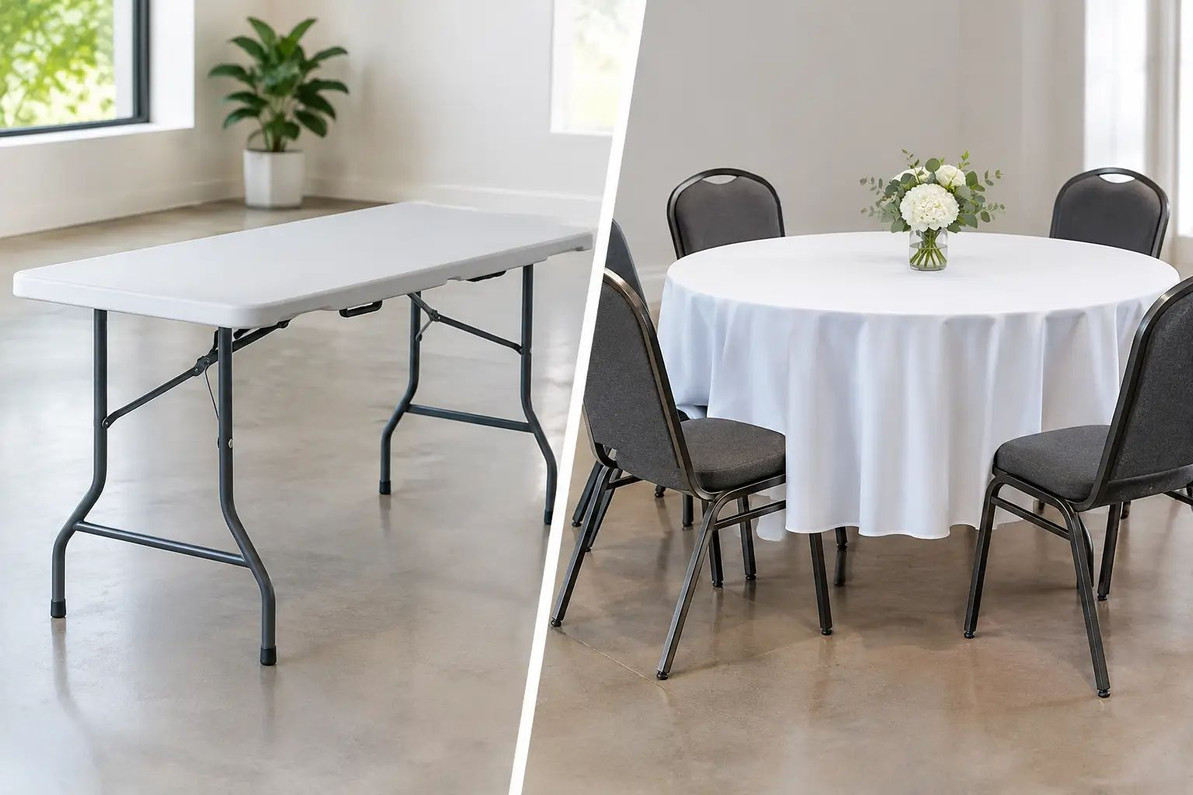
A folding table is defined by its design. Its legs fold inward, and in some models the tabletop folds in half. This makes the table easier to carry, transport, and store between uses. Folding tables come in many sizes, from compact personal tables to long rectangular models that can serve a crowd.
A banquet table is defined more by its use and dimensions. It is typically a long rectangular table designed for serving food, seating guests, holding supplies, or creating temporary workstations. Common lengths include 4, 6, and 8 feet. Traditional banquet tables may have fixed legs, but many modern banquet tables are folding tables.
That overlap matters when shopping online. A 6-foot folding table may also be sold as a folding banquet table because it meets both definitions. Instead of relying on the product name alone, check the overall dimensions, folding design, tabletop material, leg style, and listed weight capacity.
Start With the Job the Table Needs to Do
The most useful question is not whether a table is called folding or banquet. It is what you need it to handle on a regular basis.
For occasional home use, such as holiday meals, garage sales, crafts, or extra guests, a portable folding table is often the practical choice. It sets up quickly and can be stored in a closet, garage, shed, or utility room when the gathering is over. A smaller 4-foot table can work well for buffet items, gift wrapping, homework, and household projects.
For parties, community events, catering setups, rental properties, churches, school functions, and office lunches, a longer banquet-style table provides more usable space. A 6-foot table is a common all-purpose option because it gives room for food service or several seated guests without being as difficult to move as an 8-foot model. An 8-foot table can be a better fit for larger seating plans, bulk packaging tasks, or long display layouts, provided you have enough storage space and a way to transport it.
Small businesses and warehouse teams may use folding banquet tables as temporary packing stations, sorting surfaces, sign-in tables, or seasonal overflow work areas. In these settings, the ability to fold and relocate the table may be just as valuable as the long work surface.
Size, Seating, and Surface Area
Length is one of the clearest differences between a basic folding table and a banquet table. A compact folding table may be convenient, but it can become cramped if it is expected to seat several adults or hold a full buffet spread.
As a general planning guideline, a 4-foot rectangular table can seat about four people comfortably, with two on each side. A 6-foot table can usually seat six to eight people depending on chair width and whether guests are seated at the ends. An 8-foot table can often seat eight to 10 people. Leave more room when using wider chairs, place settings, centerpieces, or serving dishes.
Width also affects how useful the table feels. Narrow tables are efficient for vendor displays, entry areas, or a packing line where people work from one side. A wider tabletop is more suitable for dining and buffet service because it leaves room for plates, trays, and décor. Measure the intended area before ordering, including walking space around the table and clearance for chairs.
When planning a work surface, think beyond the tabletop size. A long table filled with shipping boxes, tools, or supplies can be difficult to use if employees cannot reach the center or move safely around it. Two shorter tables may be more flexible than one extra-long table in a tight room.
Storage and Transport Are Often the Deciding Factors
A standard folding table with folding legs usually stores flatter than a fixed-leg banquet table. That makes it a sensible option for homeowners, property managers, and organizations that only set up tables when needed. Flat storage can also make it easier to keep several tables organized along a garage wall or in a supply closet.
Some models add a folding tabletop that closes in the middle and may include a carry handle. These are especially convenient for people who transport tables in a car or SUV for pop-up sales, job sites, family events, or market displays. The trade-off is that a center-fold design has a seam across the top, which may not be ideal for certain craft projects, paperwork, or display arrangements.
Long one-piece banquet tables provide an uninterrupted work or dining surface, but they require more storage length. Before choosing a 6- or 8-foot model, measure the storage area, vehicle cargo opening, elevator, stairwell, and doorway if the table will need to move through them. A table that fits the event room but cannot be easily transported there creates a frustrating problem later.
Materials and Construction Affect Everyday Use
Most portable tables use plastic resin or molded polyethylene tops with steel folding legs. These are popular for casual dining, outdoor gatherings, work projects, and utility use because they are generally easy to wipe clean and less affected by everyday spills than unfinished wood. A textured or molded top can also be useful when the table will be moved frequently.
Wood-top banquet tables are often selected for their firm, traditional feel and broad, continuous surface. They can be a practical choice for indoor events and settings where tables are covered with linens. However, they may be heavier, need more careful storage, and may not be the best choice for damp areas or frequent outdoor use.
Leg design deserves attention as well. Look at where the legs sit beneath the tabletop. Folding legs that are positioned close to the ends can give seated guests more knee room, while cross braces may reduce open space underneath. For a packing or display table, braces may not matter much. For dining, they can affect comfort.
Check Weight Capacity and Stability Before Buying
A table's listed weight capacity should match the heaviest realistic load, not just the usual one. A dining table holding plates and serving bowls has different demands than a worktable holding boxed inventory, tools, or equipment. Capacity ratings can also vary based on whether weight is spread evenly across the tabletop or concentrated in one spot.
For heavier or repeated commercial use, review the product specifications closely. Pay attention to the tabletop material, leg gauge or construction details when provided, locking mechanisms, and any support braces. Avoid placing concentrated loads near the edges or on one corner, even if the table has a high overall capacity.
Stability also depends on setup. Always use the table on a level surface, fully open the legs, and confirm that leg locks or braces are engaged before loading it. If the table will be used outdoors, avoid uneven ground and do not rely on it for items that can blow over or shift in strong wind.
Which Option Makes More Sense for You?
Choose a smaller or standard folding table when compact storage, easy transport, and occasional flexible use are your main concerns. It is a practical fit for homes, apartments, maintenance rooms, and mobile setups where the table needs to disappear after the job is done.
Choose a banquet-size table when seating capacity or a long continuous surface is the priority. It is usually the better direction for buffet lines, events, group projects, order packing, classroom activities, and multi-person work areas.
Choose a folding banquet table when you need both. For many buyers, this is the most useful middle ground: event-ready dimensions with legs that fold for storage. Measure your space, compare the folded dimensions as carefully as the open dimensions, and select a size that works on an ordinary day as well as during a busy event.
A good table should solve a repeat problem, not become one more bulky item to work around. Whether you need extra seats for guests or a dependable surface for daily operations, choosing the right size and folding design will make setup, storage, and cleanup much easier.
Recent Posts
-
How to Organize Toys With Clear Storage Bins
Toy clutter tends to peak right before the holidays, when birthday gifts from the year are still sca …Oct 23, 2026 -
Folding Chairs for Church Halls and Community Centers
Church halls, fellowship rooms and community centers ask more of their seating than almost any home. …Oct 23, 2026 -
Restaurant Bus Cart Guide: Using a Utility Cart for Bussing
Every busy dining room hits the same wall at some point in a shift: dirty plates stack up, servers m …Oct 23, 2026