Chair Storage Options for Homes and Businesses
A stack of chairs against a wall can look harmless until it blocks a storage room, scratches flooring, or becomes difficult to move before the next event. The right chair storage options depend on the chair style, available floor space, how often chairs are used, and whether one person needs to move them or a team handles setup. A practical storage plan keeps chairs accessible, protects the investment, and makes cleanup faster.
Start With the Type of Chair You Need to Store
Before choosing a rack, cart, or storage area, identify how the chairs are built. Folding chairs, stackable banquet chairs, office guest chairs, and outdoor chairs all need different handling.
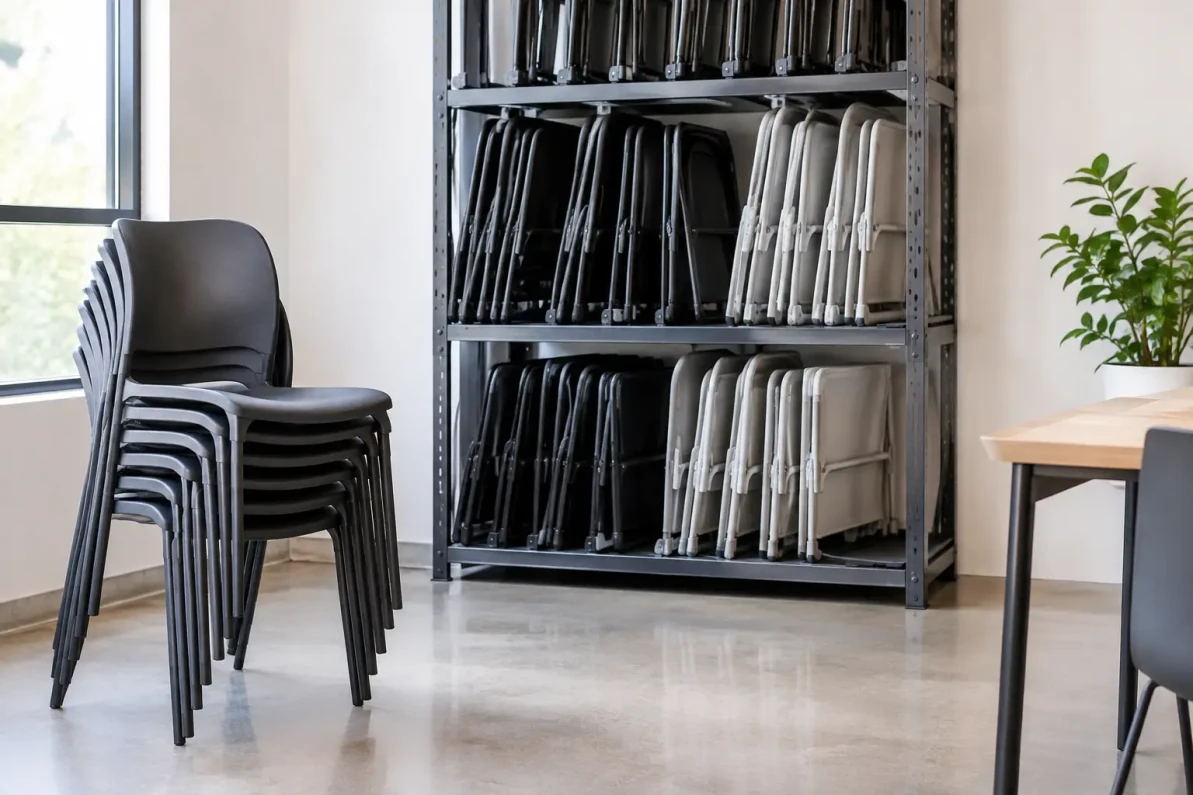
Folding chairs are usually the easiest to store compactly. When folded, they can be placed on a chair cart, a dedicated storage rack, or a clean wall-adjacent area. Their narrow profile makes them a strong choice for churches, schools, community rooms, rental properties, break rooms, and homes that need extra seating only occasionally.
Stackable chairs save space vertically, but only when the manufacturer allows stacking and specifies a safe stack height. Their frames and seat surfaces should line up correctly. Mixing different chair models in one stack may create an unstable pile or damage the chairs.
Chairs with casters, arms, upholstered backs, or delicate finishes need more care. These are often better stored in a designated room or along a protected wall rather than packed tightly into tall stacks. The goal is not simply to fit more chairs into less space. It is to make the next setup easier without creating unnecessary wear.
Common Chair Storage Options Compared
Folding chair carts
A folding chair cart is a practical choice for facilities that regularly set up and take down seating. It keeps chairs grouped together and turns a repeated carrying job into a rolling load. This can be especially useful in event spaces, offices, warehouses, places of worship, schools, and multi-use rooms.
When comparing carts, check the chair capacity, overall cart dimensions, wheel style, and whether the cart is designed for the size and shape of your chairs. Capacity numbers are useful, but aisle width and doorway clearance matter just as much. A fully loaded cart that cannot pass through a storage-room door will not solve the problem.
Carts require floor space, so they are best for locations with a dedicated storage area. They also work well when chairs need to travel between rooms or from a warehouse area to a setup location.
Vertical chair racks
Vertical racks store folding chairs upright in a compact footprint. They can be a good fit for smaller storage rooms, closets, maintenance areas, and garages where floor space is limited. Since the chairs are stored in a defined position, racks also make it easier to count inventory and keep different chair types separated.
The trade-off is loading height. Staff should be able to place and remove chairs without reaching awkwardly or forcing chairs into position. Measure both the rack area and the clearance above it before purchasing. Pipes, shelving, garage doors, and low ceilings can limit where a vertical rack will fit.
Horizontal storage racks
Horizontal racks generally hold folded chairs in a lower, longer arrangement. They are easier to load than tall vertical systems and may be a better match for users who want quick access to a smaller number of chairs. A horizontal setup can also make sense under shelving, along the edge of a warehouse, or in a long utility room.
This option uses more wall length than a vertical rack. It is most useful when the room has available perimeter space but little overhead clearance.
Stacking dollies and transport carts
For stackable chairs, a purpose-built dolly or transport cart can protect the chair stack while simplifying movement. These carts are common where seating changes often, such as meeting rooms, event venues, training areas, and dining spaces.
The chair frame must match the cart design. Do not assume any stackable chair will fit any dolly. Check the chair base shape, stack direction, cart platform size, and rated capacity. A cart that is too narrow or too short may leave the stack unsupported.
Wall storage and shelving zones
For small chair quantities, a marked wall zone may be enough. Folding chairs can be stored neatly against a clean, dry wall with enough room to remove one chair at a time. In a garage, workshop, or maintenance room, keeping chairs off the main work path helps prevent dents and trip hazards.
Wall hooks or mounted storage systems can be useful for certain folding chair designs, but compatibility and mounting strength matter. Use hardware appropriate for the wall construction and the total loaded weight. If chairs are used frequently, a floor-based rack or cart is often faster to manage.
Protective covers and storage bags
Covers do not replace a rack or cart, but they can add useful protection. Dust covers are helpful for chairs stored seasonally, in warehouse areas, or in rooms with ongoing maintenance activity. Individual chair bags can be practical for premium chairs or for keeping outdoor chairs clean between uses.
Covers work best when chairs are clean and fully dry before storage. Trapping moisture under a cover can create odor, staining, or material damage. For long-term storage, use a dry area with reasonable air circulation rather than an unconditioned space prone to dampness.
How to Choose the Right Storage Setup
The most suitable option comes down to four practical questions: how many chairs you own, how often they move, where they will be stored, and who will handle them.
For a homeowner with eight to 20 folding chairs, a compact rack or an organized wall zone may be enough. A property manager storing chairs for a clubhouse or shared amenity room may benefit from one or more rolling carts. A warehouse, event business, school, or organization with larger quantities should plan for transport paths, inventory separation, and enough space to load carts safely.
Measure before ordering. Record the folded chair width, depth, and height, then measure the available storage footprint, door openings, elevator dimensions if applicable, and turns in hallways. It is easy to focus on how many chairs a rack holds and overlook the route from storage to the room where chairs are used.
Also consider the floor. Smooth, level floors are easier for loaded carts. Thresholds, rough pavement, ramps, and uneven surfaces may require larger wheels or a different transport approach. If chairs must be moved outdoors, protect them from rain and avoid leaving metal frames on wet ground.
Organize Chairs for Faster Setup and Cleanup
A good storage system should reduce confusion, not add another task. Store matching chairs together and label carts, rack locations, or storage zones by chair type and quantity. For example, keep folding chairs separate from stackable chairs, and separate indoor seating from outdoor-use seating.
If your facility uses chairs for different room layouts, assign each cart or storage section a purpose. One cart might hold chairs for a conference room, while another is reserved for training events. This makes inventory checks simpler and prevents last-minute searching.
Keep a clear aisle around stored chairs. Do not place boxes, cleaning supplies, ladders, or other equipment where they prevent access to a cart. In busy stockrooms and warehouses, protecting the travel path can be as valuable as choosing the cart itself.
For seasonal seating, clean chairs before putting them away. Wipe down frames, remove loose debris from hinges and seat surfaces, and check for damaged feet, loose fasteners, or torn pads. Set aside chairs that need attention rather than returning them to the active stack. This avoids finding damaged seating during the next event setup.
Avoid These Common Storage Mistakes
Overstacking is one of the most frequent problems. Even when chairs appear stable, stacking higher than recommended can strain frames, mark seat surfaces, and make the top chairs difficult to remove. Follow the chair manufacturer's stacking guidance rather than estimating by eye.
Another mistake is storing chairs where they are likely to be bumped by carts, pallets, or moving equipment. A simple barrier, dedicated rack, or clearly marked storage zone can reduce damage in a busy utility area.
Avoid storing chairs directly in damp basements, under leaking pipes, or against exterior walls that collect condensation. For folding chairs, check hinges periodically. For upholstered seating, avoid placing heavy items on top of stacks or compressing fabric against rough surfaces.
Build a Storage Plan That Fits Your Space
The best chair storage options make seating easier to use, not harder to manage. A compact rack may be all a home or small office needs, while a rolling cart can save substantial time for an event room or commercial facility. Choose based on chair compatibility, storage dimensions, movement needs, and the condition of the space.
Easy Deal USA offers practical storage and material-handling solutions for customers who need to keep everyday spaces, work areas, and facilities organized. Start with accurate measurements, leave room to move, and select equipment that matches how your chairs are actually used. A well-planned chair area stays orderly long after the room has been reset.
Recent Posts
-
Frigidaire Fridge Door Shelf Rail Broken: Replace 240534901
If the door shelf rail on your Frigidaire refrigerator has cracked, snapped off or keeps popping loo …Nov 21, 2026 -

Storage Totes for Contractors: Truck and Jobsite Guide
Every contractor knows the cost of a disorganized truck. You drive to the job, then spend twenty min …Nov 21, 2026 -
How to Pack a Heavy Box for Shipping Without Blowouts
A heavy box fails in predictable ways. The bottom seam splits when someone lifts it, a corner crushe …Nov 21, 2026