Best Dollies for Apartments and Small Moves
A dresser that fits perfectly in your bedroom can become a serious moving problem once it reaches a narrow hallway, elevator threshold, or tight apartment doorway. The best dollies for apartments are not necessarily the largest or highest-capacity models. They are the ones that let you move common household items with control, fit into limited storage space, and roll smoothly over the surfaces found in multi-unit buildings.
For most renters, homeowners, landlords, and maintenance crews, choosing a dolly starts with the item being moved. A compact furniture dolly works very differently from a hand truck or a platform cart. Understanding those differences before buying can save time, prevent damaged floors, and make move-in day much less frustrating.
How to Choose the Best Dollies for Apartments
Apartment moves involve more turns, shared spaces, and surface changes than many garage-to-driveway jobs. You may need to cross carpet, tile, laminate flooring, elevator gaps, entry mats, and loading docks in the same trip. That makes wheel material, platform size, and maneuverability just as relevant as stated weight capacity.
Start by considering the largest and most awkward item you expect to move. For a stack of moving boxes, storage totes, small appliances, or bulk household supplies, a folding platform cart is usually the most convenient choice. For a bookcase, compact sofa, file cabinet, or boxed furniture, a flat furniture dolly may be better. If you need to move a refrigerator, washer, dryer, or tall cabinet, use a purpose-built appliance hand truck rather than trying to balance the item on a general-use dolly.
Capacity should provide a comfortable margin above the weight of the load. The number on a product listing is useful, but it does not replace proper loading. A dolly can be rated for a substantial load and still become hard to control if weight is stacked too high, placed off-center, or allowed to shift during transport.
Choose wheels for the building, not just the load
Wheels determine how a dolly feels in real use. Hard wheels can roll efficiently on smooth concrete and warehouse floors, but they may be noisy or less forgiving on interior surfaces. Larger rubber or non-marking wheels are often a practical choice for apartment buildings because they handle small floor transitions and help reduce the chance of scuffing finished floors.
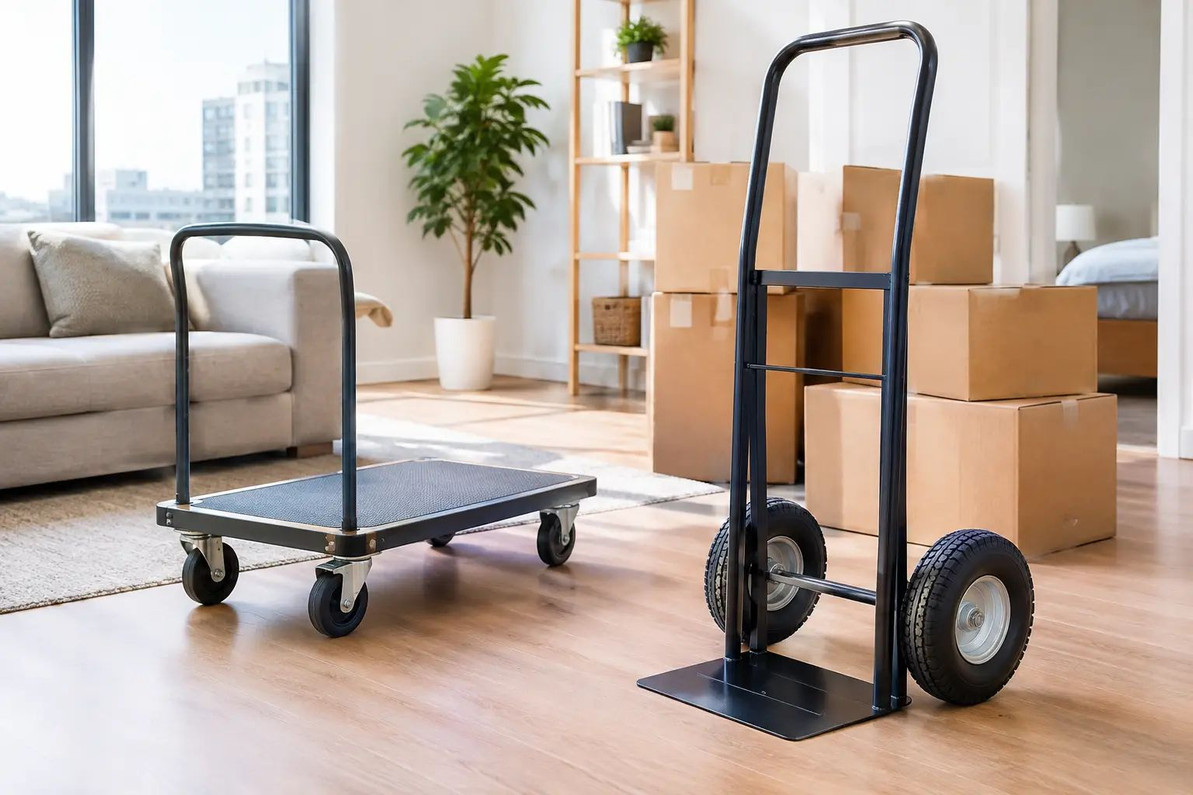
Swivel casters are especially useful in hallways and inside apartments where there is little room to make a wide turn. Four swivel casters provide excellent steering around corners, although a heavily loaded cart may require more care to keep moving straight. A hand truck with two larger wheels is easier to guide in a direct line and can handle uneven outdoor paths better, but it needs room to tilt back and turn.
Check the wheel diameter as well as the wheel material. Small casters are fine for smooth, level floors and lighter loads. Larger wheels are more helpful when rolling over elevator seams, door thresholds, sidewalk joints, and loading-area surfaces.
The Main Dolly Types for Apartment Moving
A furniture dolly is a low, flat platform with four casters. It is a practical choice for large boxes, low furniture, end tables, ottomans, small cabinets, and other items that can rest securely on a flat base. Its low height makes loading easier than lifting an item onto a tall cart, but it does not support tall or narrow loads by itself. Moving blankets and tie-down straps can help protect furniture and keep it stable.
A folding platform cart is often the most versatile option for apartment residents. Its upright handle gives you better control over stacked boxes, grocery-sized cartons, storage bins, and small equipment. Many models fold down for closet, utility-room, or car-trunk storage, which matters when every square foot counts. Look for a platform large enough for your usual box size without choosing a cart so wide that it becomes awkward in standard hallways.
A two-wheel hand truck, also called a utility dolly, is designed to slide under a load and tilt it back for transport. It is useful for tall boxes, water cases, compact appliances, and moving supplies. The trade-off is that it requires more balance and technique than a four-wheel platform. It is best when the load can be strapped securely against the frame and the route has enough space for controlled turns.
An appliance dolly is for major appliances and other tall, heavy items. These models typically have features intended to secure and support large loads while tilted. They are not the everyday choice for boxes and small furniture, but they are the right tool when moving a washer, dryer, refrigerator, or similar item. Confirm the appliance dimensions, route clearance, and handling requirements before starting. Some apartment buildings also have move-in procedures or elevator reservation rules worth checking in advance.
For people who occasionally move or rearrange furniture, compact furniture sliders can also be helpful inside the apartment. They are not a replacement for a dolly when moving through corridors or elevators, but they can make it easier to reposition a sofa or cabinet across a suitable floor surface.
Match the Dolly to Your Most Common Jobs
A good apartment dolly does not need to handle every possible moving task. It should handle the jobs you actually have. A renter moving once a year and receiving frequent deliveries may get the most value from a folding platform cart. A property manager moving supplies between units may prefer a sturdy platform cart with a larger deck and dependable casters. A maintenance professional may need both a hand truck for equipment and a flat dolly for boxed materials.
Think about storage before choosing a large cart. Measure the spot where it will live - a hall closet, laundry area, storage locker, garage, or vehicle. Folding handles and compact frames are helpful, but review the folded dimensions rather than assuming a product will fit.
Also consider the cart's own weight. A heavier steel dolly can be a durable option for regular work, but a lighter aluminum or folding design may be easier to carry down stairs, lift into a vehicle, or store on a shelf. There is no single right material. The better option depends on whether the dolly will be used occasionally at home or frequently for work.
Details That Make a Dolly Easier to Use
The most useful features are often simple ones. A textured platform can help reduce load movement. Raised edges or corner bumpers can add a little extra security for boxes and furniture. A handle with a comfortable grip is easier to use during longer trips from an apartment to a parking area or loading zone.
A folding handle should lock firmly in both open and closed positions. On a platform cart, confirm that the handle height feels comfortable for the person who will use it most often. A handle that is too short can make it harder to steer stacked boxes without bumping your heels.
For furniture dollies, pay attention to deck size and padding. A larger deck supports bulky items more evenly, while carpeted or padded surfaces can help protect finished furniture. However, padding does not eliminate the need for moving blankets when transporting wood, glass, or upholstered pieces through a building.
Brakes can be useful when loading on a slight incline or pausing near an elevator, but they are not a substitute for keeping control of the cart. If your route includes ramps, take smaller loads and avoid leaving a loaded dolly unattended.
Safer Loading for Tight Spaces
The safest load is low, centered, and secured. Put heavier boxes on the bottom, keep the stack below your line of sight when possible, and avoid piling items so high that they interfere with doorways or elevator controls. A cart overloaded with light but bulky boxes can be just as difficult to manage as one carrying a dense, heavy item.
Measure the narrowest point of the route before loading. Apartment doors, elevator openings, and turns near stairwells are common trouble spots. Measure the item and the cart together if the item will extend beyond the platform. A few minutes of planning can prevent the need to unload and restack in a crowded hallway.
Use straps when transporting furniture, tall boxes, or anything that could slide during a turn. Keep hands and feet clear while lowering a load, and ask for help with oversized items. A dolly reduces carrying, but it does not make a large item easier to control in every situation.
When a Small Cart Is the Better Buy
More capacity is not always better for apartment living. An oversized platform can be difficult to store, harder to maneuver in elevators, and unnecessary for a few boxes at a time. If your main goal is moving deliveries, storage bins, seasonal decorations, or supplies from the car to your unit, a compact folding cart can be the better long-term purchase.
On the other hand, if you regularly handle heavier furniture, maintenance materials, or inventory for a small business, a stronger furniture dolly or larger platform cart may be worth the extra space. Easy Deal USA offers practical material-handling options for customers who need equipment that fits real home, business, and storage tasks.
The right dolly should make your route feel manageable, not add another bulky item to your closet. Choose the style that fits your typical load, measure the spaces you need to travel through, and give yourself enough capacity and wheel clearance for the job ahead.
Recent Posts
-
How to Organize Toys With Clear Storage Bins
Toy clutter tends to peak right before the holidays, when birthday gifts from the year are still sca …Oct 23, 2026 -
Folding Chairs for Church Halls and Community Centers
Church halls, fellowship rooms and community centers ask more of their seating than almost any home. …Oct 23, 2026 -
Restaurant Bus Cart Guide: Using a Utility Cart for Bussing
Every busy dining room hits the same wall at some point in a shift: dirty plates stack up, servers m …Oct 23, 2026