
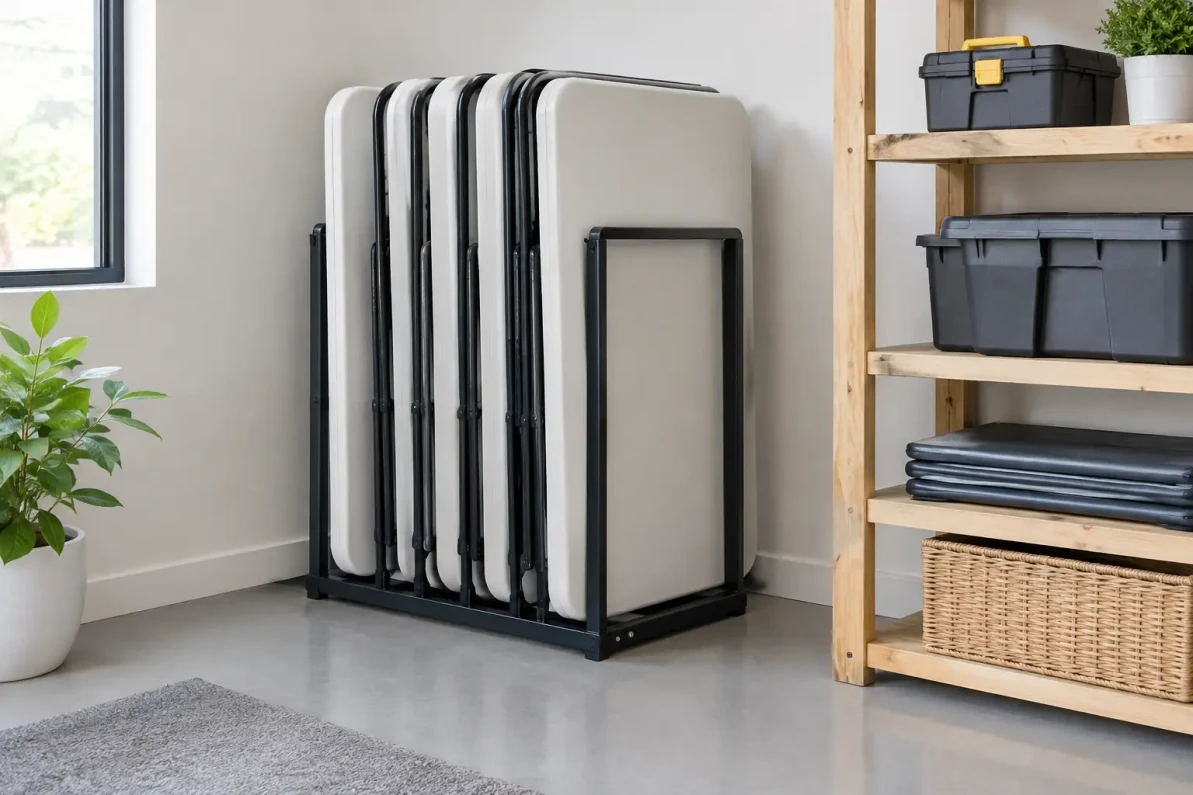
How to Store Folding Tables Without Wasting Space
A folding table earns its keep when guests arrive, a project needs extra work space, or a business needs quick event seating. The problem starts after use: knowing how to store folding tables without blocking a garage aisle, damaging the tabletop, or creating a hard-to-move stack. The right method depends on the table’s size, weight, folding style, and how often you need it.
Start With a Clean, Fully Folded Table
Storage begins before the table reaches the storage area. Wipe the tabletop with a mild cleaner appropriate for its material, then dry it completely. Food residue, moisture, tape adhesive, and dirt can stain surfaces or leave metal hardware vulnerable to corrosion over time.
Fold the legs according to the table’s locking design. Check that each leg is tucked in fully and that any latches are engaged. A partially folded table takes up more room, catches on nearby items, and can shift unexpectedly when leaned against a wall.
Before stacking several tables, inspect the feet, hinges, and underside hardware. Replace missing caps or damaged components when possible. Plastic foot caps protect both the table frame and the floor, particularly when tables are moved frequently across concrete in a garage, warehouse, church hall, or community room.
Choose the Storage Position Based on Table Type
Most rectangular folding tables are best stored vertically on their long edge. This keeps their footprint small and makes it easier to slide one table out without moving a full pile. Place the edge on a clean, dry surface and keep the table steady with a rack, strap, or other support designed for the load.
Vertical storage is practical for common 4-foot, 6-foot, and 8-foot banquet-style tables, but it is not the best choice for every model. Very heavy tables can be difficult to lift upright safely, while lightweight plastic tables may bow if they are stored poorly for long periods. If a tabletop flexes easily, use a storage rack that supports it in several places instead of relying on one narrow edge.
Round folding tables usually store differently. Their circular shape makes wall-leaning less stable, especially when several are grouped together. A dedicated vertical rack or an upright storage cart with dividers is often the cleaner option. If floor space is available, horizontal stacking may work well for round tables as long as the stack is low, level, and protected between surfaces.
Small card tables and personal folding tables can often be stored flat on a shelf, under a bed, or in a closet. Keep heavy boxes off the stack. Even compact tables can develop warped tops or bent frames when used as a platform for other stored items.
Avoid Storing Tables on Their Legs
Do not leave folding tables standing open for long-term storage unless they are actively being used. Open tables consume far more floor space, invite clutter underneath, and place unnecessary pressure on the leg joints. They are also easier to bump in a busy garage, stockroom, or work area.
Use a Storage Method That Matches Your Space
A simple wall-adjacent setup can work for one or two household tables. Position the folded tables upright along a wall where they will not interfere with vehicles, doors, electrical panels, or walkways. Add a nonslip mat or a narrow strip of wood at the base if needed to prevent the edges from sliding on smooth concrete.
For a larger collection, a purpose-built table storage rack offers better organization. Racks keep tables separated, reduce leaning and shifting, and make it easier to count available inventory. They are useful for property managers, event spaces, schools, offices, places of worship, and small businesses that set up tables regularly.
A rolling table cart is worth considering when tables must move between rooms or from storage to a loading area. Look for a cart sized for the table dimensions you use, with a capacity that matches the total weight of the load. Casters are convenient, but they work best on reasonably smooth floors. On rough pavement, thresholds, or uneven surfaces, a platform cart or dolly may be a more practical choice for transporting tables one group at a time.
Wall-mounted storage can free up floor space, but it needs careful planning. Use mounting hardware and wall supports rated for the combined weight of the tables, and do not rely on light-duty hooks for heavy commercial tables. Keep stored tables low enough to remove without overreaching. For most households, floor-level vertical storage is simpler and easier to manage.
Protect the Tabletop From Scratches and Moisture
Tabletops can get scratched when metal legs, exposed bolts, or rough edges rub against them during storage. If you stack tables, place a thin protective layer between each one. Clean moving blankets, cardboard sheets, felt pads, or foam panels can work well, provided they are dry and free of grit.
Avoid wrapping a damp table tightly in plastic for extended periods. Plastic can trap moisture against the surface, particularly in humid garages, sheds, and basements. A breathable furniture cover or moving blanket is usually a better choice for tables stored through a season.
Keep tables away from direct water exposure. A storage location near a leaking window, damp exterior wall, or unsealed concrete floor can damage particleboard-style cores, loosen laminate edges, or rust steel components. If your only available space is a basement or garage, raise tables slightly off the floor with a rack, shelf base, or pallets that are clean and in good condition.
Organize Tables for Faster Setup
The best storage arrangement is not just compact. It should also make the next setup easier. Store similar tables together by size and shape. Keep 6-foot rectangular tables in one section, round tables in another, and smaller card tables on a separate shelf or rack. This saves time when you need a certain size for a meeting, yard sale, packaging station, or family gathering.
For businesses and organizations, label storage zones rather than individual tables unless there is a specific inventory reason to label each unit. A simple sign such as “6-Foot Tables” or “Round Tables” helps volunteers, staff, and customers return equipment to the right place. Store matching accessories nearby, including table covers, clips, folding chairs, and carts, but do not pile them on top of the folded tables.
If tables are used frequently, place the most-used units closest to the exit or work area. Reserve upper shelves, back corners, or longer-term storage locations for seasonal tables. This rotation reduces unnecessary lifting and keeps daily operations moving.
Plan for Safe Lifting and Moving
Folding tables can be awkward even when they are not especially heavy. Their length shifts the center of gravity away from your body, and folding mechanisms can pinch fingers if handled carelessly. Carry larger tables with two people when practical, especially 6-foot and 8-foot models.
When moving a table alone, keep it folded and secured. Lift with a stable grip on the frame, not just the tabletop edge or a leg. Use a utility cart, platform cart, or dolly for multiple tables, long distances, or repeated transport. This is faster than making several trips and helps prevent scuffed walls, damaged door frames, and dropped tables.
Do not create tall, unstable stacks just to save a few square feet. A lower, organized stack is easier to access and less likely to shift. If storage space is tight, adding a vertical rack or using an unused wall section is usually a better answer than piling tables higher.
Common Folding Table Storage Mistakes
A few habits cause most storage damage. Leaning tables loosely against a wall may seem convenient, but the first table can slide when another item is moved. Stacking tables face-to-face without protection can scratch finished surfaces. Leaving tables directly on a damp floor can damage both tops and frames.
Another common mistake is using a table storage area as general overflow storage. Boxes, tools, and seasonal items quickly turn a simple table stack into a blocked-off corner. Give folding tables a defined location with enough room to remove one without unloading everything around it.
For homes, workplaces, and event spaces alike, a clean, dry, organized storage spot makes folding tables easier to use and helps them stay ready for the next job. A modest rack, cart, or protected wall area can save more space and frustration than trying to force tables into an already crowded corner.
Recent Posts
-
Moving Dolly Capacity for Real-World Loads
A dolly rated for 800 pounds can still be the wrong choice for a 500-pound load. The issue is not al …Nov 21, 2026 -
Frigidaire Fridge Door Shelf Rail Broken: Replace 240534901
If the door shelf rail on your Frigidaire refrigerator has cracked, snapped off or keeps popping loo …Nov 21, 2026 -
Storage Totes for Contractors: Truck and Jobsite Guide
Every contractor knows the cost of a disorganized truck. You drive to the job, then spend twenty min …Nov 21, 2026
